Impact Sprinkler Guide: Working Principle, Sizing, Spacing and Agricultural Applications
2026-08-25
Impact Sprinkler Guide: Working Principle, Sizing, Spacing and Agricultural Applications
A dry week at the wrong moment can cut orchard yield by a measurable share, and pasture that stalls in July takes months to recover. Impact sprinklers — the pulse-driven heads that have watered farms for decades — remain one of the most cost-effective tools for covering large areas with simple, repairable hardware. This guide covers how they work, how to size and space them for agricultural duty, which crops they suit best, and how to buy them factory-direct.
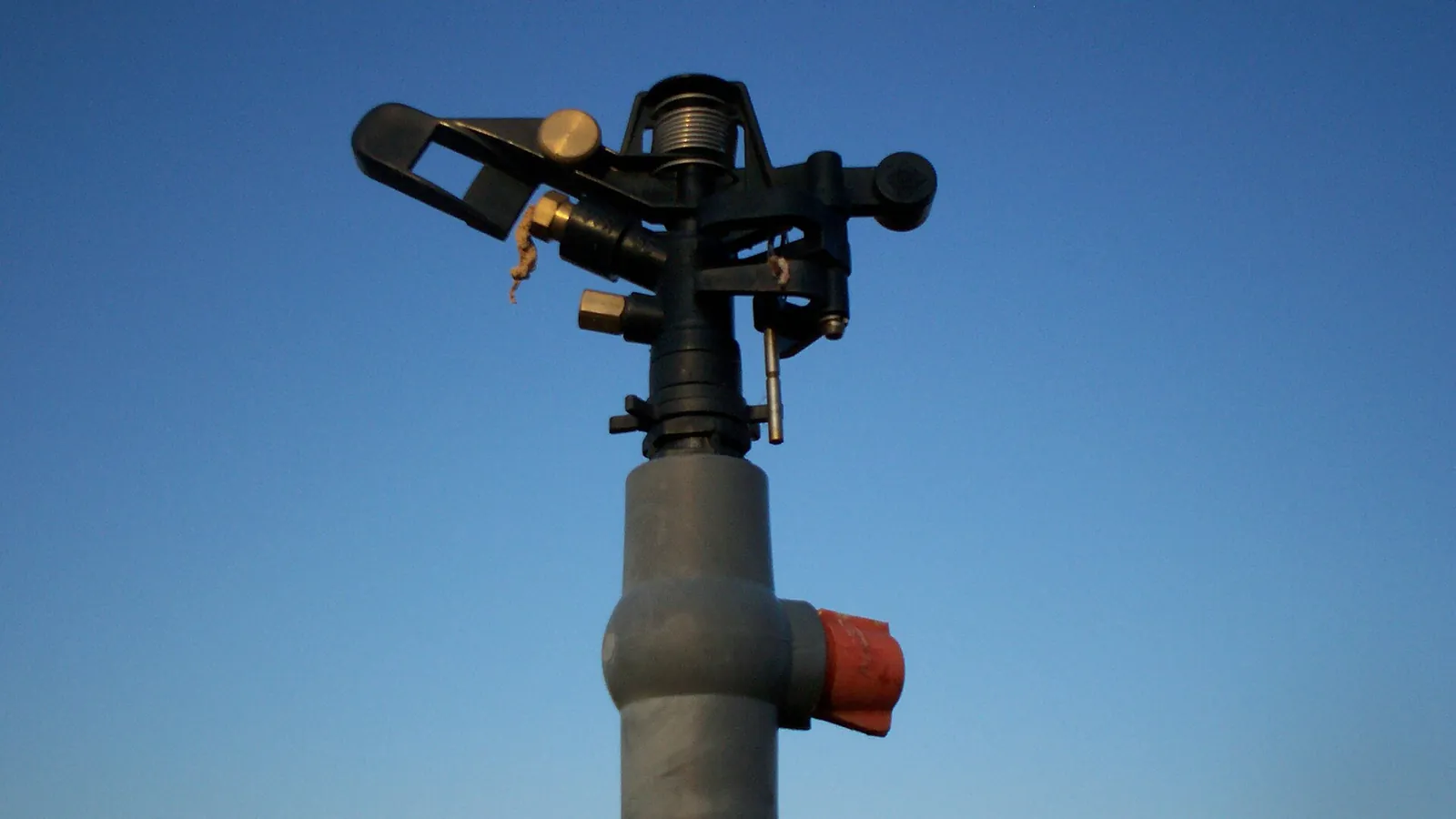
The Snapshot
- Impact sprinklers throw water 12–18 m at 2.5–5 bar; high-flow industrial models reach 25–40 m and 20–40 m³/h
- Spacing rule: 50–65% of wetting diameter for acceptable distribution uniformity
- Rotation is mechanical — a spring-loaded arm struck by the water stream — so there are no gears to strip and dirty-water tolerance is high
- Part-circle models cover 20°–340°; full-circle covers 360°
- Wear items (nozzles, springs, seals) are replaceable — the head is a long-life asset with a parts ecosystem
How an Impact Sprinkler Works
The impact sprinkler — also called an impulse or pulse sprinkler — converts water pressure into rotation with no motor and no electronics.
The core mechanism
Water exits the nozzle as a focused stream and strikes a deflector plate. The stream’s force pushes a spring-loaded trip arm outward; when the arm reaches its limit it snaps back under spring tension. That snap — the “impact” — strikes the body of the sprinkler and nudges the head a few degrees around its bearing. Each pulse advances the rotation, so the head sweeps a full or partial circle in a series of small steps.
Key components:
| Component | Role |
|---|---|
| Nozzle | Shapes the stream; orifice size drives flow and droplet size |
| Deflector plate | Redirects the stream; angle sets spray pattern and part-circle position |
| Trip arm + spring | Generates the impact pulse that drives rotation |
| Bearing | Supports rotation; quality bearings extend service life |
| Base / inlet | Threaded connection (typically 1/2”–3/4” male BSPT or NPT) |
Why the design matters on a farm
Because rotation is purely mechanical, impact heads keep working when water carries sediment, algae or reclaimed water that would clog fine gear-driven rotors. The large nozzle passages and open construction make them the default choice for dirty-water, high-wear conditions — irrigation ponds, dug wells, and systems that run season after season without fuss.
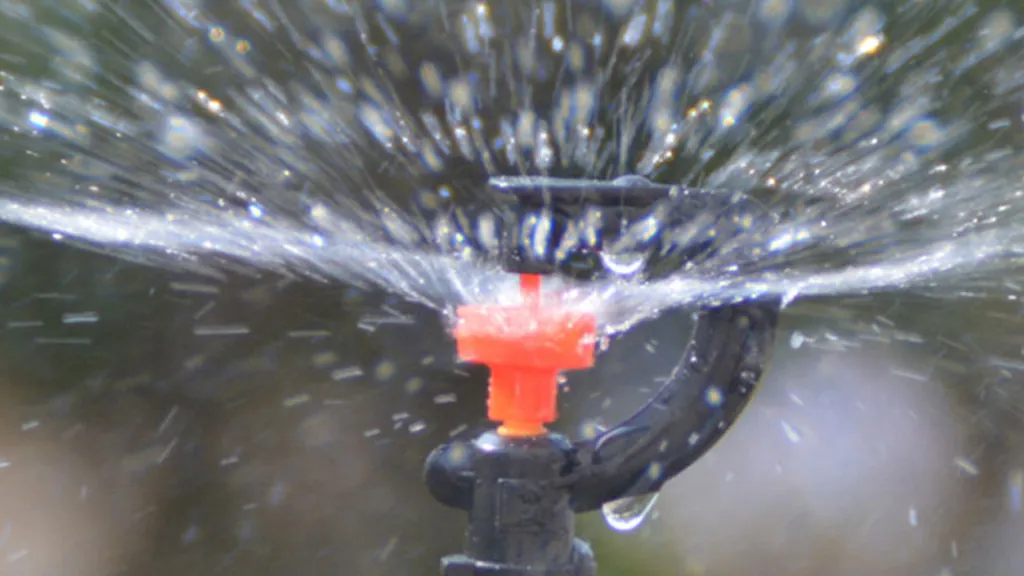
Sizing an Impact Sprinkler for Agricultural Duty
Sizing means matching the head to your water supply, not the other way around. Three numbers matter: pressure, flow and throw.
Operating pressure
Most agricultural impact sprinklers run at 2.5–5 bar. Below about 2 bar, throw distance collapses and distribution uniformity drops. If your pump delivers less, consider low-pressure models or a smaller spacing plan rather than pushing a head past its design point.
Flow and nozzle size
Flow depends on nozzle orifice and pressure. Typical ranges:
| Nozzle size | Flow at 3 bar | Best for |
|---|---|---|
| Small (1/8” class) | 0.5–1.5 m³/h | Small plots, low-flow pumps |
| Medium (3/16” class) | 1.5–4 m³/h | Orchards, pastures, field crops |
| Large (1/4” class) | 4–10 m³/h | Large open areas, dust control |
| High-flow industrial | 20–40 m³/h | Mines, stockpiles, big field systems |
Color-coded nozzles (the industry standard) make it easy to identify flow rate in the field — the same color system Rain Bird and Nelson use on their agricultural lines.
Throw radius
Throw depends on pressure and nozzle. At 2.5–5 bar, most agricultural heads throw 12–18 m. High-flow industrial heads reach 25–40 m. Use the manufacturer’s published throw at your actual pressure — don’t size from the maximum figure printed on the box.
Spacing and Layout Rules
Spacing drives uniformity, and uniformity drives crop response. The standard rule for impact sprinklers:
Spacing = 50–65% of wetting diameter (wetting diameter = throw radius × 2)
For a 15 m radius head: wetting diameter = 30 m, so spacing = 15–19.5 m between heads. Tighter spacing (50%) gives better uniformity but costs more pipe and heads; wider spacing (65%) saves money but risks dry spots and wind distortion.
Other layout rules:
- Wind: In windy areas, reduce spacing toward 50% and consider part-circle heads to keep water on the crop
- Sprinkler layout: Triangular spacing gives more uniform coverage than square for a given head count
- Riser height: Higher risers (1–2 m) clear tall crops and improve throw; lower risers suit ground crops
- Pressure variation: Keep pressure variation across the system within about 10% for even distribution
Agricultural Applications by Crop
Orchards and vineyards
Impact heads suit tree and vine crops well: large droplets resist wind drift, part-circle settings water between rows without wasting water on the aisle, and the same heads provide frost protection in spring (overhead sprinkling uses the heat released when water freezes, holding vine buds near 0°C on frost nights). Typical spacing 12–18 m depending on row width and tree size.
Pasture and grazing land
Rotational paddocks benefit from portable or permanently mounted impact heads. The mechanical design survives dust, insects and years of field service. Typical spacing 15–20 m, pressure 3–4.5 bar.
Field and row crops
Impact heads cover large open areas economically. For leafy greens and root crops, match the nozzle to crop water demand (typically 25–40 mm/week in peak season) and schedule accordingly.
Greenhouses and nurseries
Overhead impact sprinklers in greenhouses wet large bench areas quickly, lift humidity and pull heat out of the air on summer days. Spacing at 60–80% of wetting diameter works well under cover (less wind distortion). For frost-sensitive seedlings, the same system provides overhead frost protection.
Dust control (industrial)
High-flow impact sprinklers (20–40 m³/h, 25–40 m throw) are used on haul roads, stockpiles and blast areas to suppress fugitive dust. They tolerate dirty water and run continuously on simple timers.
Impact vs. Rotary vs. Drip
| Factor | Impact | Rotary (gear) | Drip |
|---|---|---|---|
| Mechanism | Spring-loaded arm (pulse) | Internal gears (smooth) | Emitters at root zone |
| Throw | 12–18 m (ag) | 6–15 m | Point source |
| Dirty water | High tolerance | Medium (fine passages) | Low (clogs) |
| Uniformity | Good (CU 75–85% well-spaced) | Very good | Excellent per plant |
| Cost per head | Low | Medium | Medium-high |
| Maintenance | Simple, repairable | More complex | Emitter cleaning |
| Best for | Large areas, dirty water, frost protection | Turf, even low-rate watering | Rows, shrubs, high-efficiency |
| Typical spacing rule | 50–65% wet diameter | 50–60% | 0.3–1 m between emitters |
Rule of thumb: pick impact for open-area agricultural coverage with tough conditions; rotary for turf-quality uniformity; drip where water efficiency per plant matters most and water is clean.
Maintenance and Wear Parts
Impact sprinklers are low-maintenance but not no-maintenance. The wear items — and the parts that drive repeat orders:
| Part | Wear pattern | Check interval |
|---|---|---|
| Nozzle | Orifice erodes, flow drifts +5–10% | Season start |
| Spring | Fatigue, weak pulse | Season start |
| Trip arm | Wear at contact point | Annually |
| Seals | Leak at inlet | Annually |
| Bearing | Stiff rotation | Every 2–3 years |
A simple seasonal check — clean the nozzle, inspect the spring, confirm full rotation — keeps heads working for many seasons. Because these parts are standard and replaceable, a well-chosen head is a long-life asset rather than a throwaway.
Buying Factory-Direct and OEM
As a factory-direct manufacturer, IRRIGRAIN supplies impact sprinklers, rotary heads, pop-up heads, micro sprinklers and replacement nozzles. Buying direct means:
- Factory pricing — typically 30–50% below equivalent distributor brands
- OEM options — custom nozzle sizes, body materials, colours and private labelling
- Low MOQ — start with a trial order, scale as you grow
- Parts support — nozzles, springs and service kits stocked so you reorder, not replace
Agricultural Selection Decision Flow
When a farm or contractor needs to choose between impact, rotary, pop-up or micro sprinklers, a structured decision flow removes guesswork:
- Define the crop and its water demand — leafy greens need 25–40 mm/week in peak season; orchard trees need deep, less frequent water; pasture needs even coverage across paddocks.
- Check the water source — flow rate (m³/h), pressure (bar), and water quality. Dirty or reclaimed water pushes you toward impact heads; clean filtered water opens the drip option.
- Map the block — area, shape, row orientation, obstacles. Odd shapes favor part-circle impacts; open rectangles favor full-circle with triangular spacing.
- Match head to throw — at your actual pressure, confirm the head throws at least 60% of the longest block dimension from a corner position, or plan a second row.
- Run the spacing math — spacing = 50–65% of wetting diameter. Count heads, estimate flow per zone, check the pump can feed the largest zone simultaneously.
- Decide the control scheme — manual valves, solenoid valves with timers, or full smart control with soil moisture sensors.
- Budget the system — heads, pipe, fittings, valves, pump and installation. Factory-direct head pricing typically cuts 30–50% off the hardware line.
Irrigation Scheduling with Impact Sprinklers
Scheduling is where impact systems either shine or waste water. Two principles matter:
Depth per irrigation. Crops need a total weekly depth (e.g. 25–40 mm for vegetables in peak season, 30–50 mm for orchard in summer). Divide by the system’s application rate to get run time. An impact head applying 10 mm/h over its spacing covers the weekly demand in 2.5–4 hours per week, split across 2–3 irrigations.
Apply when the plant can use it. Early morning beats midday (less evaporation, less leaf scorch); night irrigation suits hot climates but raises disease risk in humid crops. Overhead impact sprinkling on disease-prone crops (tomatoes, some vine crops) should be done early so foliage dries by nightfall.
Simple scheduling math example: a pasture block with heads spaced 18 m, each head delivering 1.5 m³/h at 3 bar. Application rate ≈ 1.5 / (18 × 18) × 1000 ≈ 4.6 mm/h. For 30 mm/week, run ≈ 6.5 hours/week — two 3-hour irrigations in a typical dry week, or three 2-hour runs for sandy soils.
Economics: Why Factory-Direct Changes the ROI
The hardware cost of an impact sprinkler system is the entry ticket; the economics depend on price per head and lifetime cost.
| Scenario | Distributor-priced heads | Factory-direct heads |
|---|---|---|
| 40-head orchard system | $600–1,200 | $400–800 |
| 100-head pasture block | $1,500–3,000 | $1,000–2,000 |
| Replacement nozzles (annual) | $200–400 | $120–250 |
| 5-year parts cost | $800–1,600 | $500–1,000 |
Indicative ranges based on typical market pricing; actual quotes depend on model and volume.
Because impact heads are repairable — replace the nozzle and spring rather than the whole head — the 5-year cost of ownership is dominated by parts, which is exactly where factory-direct pricing compounds. A system that saves 30–50% on heads and 30–50% on parts pays for the irrigation investment measurably faster.
The Bottom Line
Impact sprinklers remain the workhorse of agricultural irrigation because they are simple, tough and economical — and the agricultural B2B guide space is far less crowded than the residential lawn content that dominates SERPs. Size to your pressure and crop, space at 50–65% of wetting diameter, and buy factory-direct for the best price.
The practical takeaway for a farm manager, contractor or distributor is straightforward. Start with the water you actually have: measure flow and pressure at the block, not what the pump brochure claims. Then choose the head class that matches the crop and the water quality — impact for tough, dirty-water, large-area duty; rotary where you want the smoothest possible distribution on turf; drip where water efficiency per plant is the priority and the water is clean. Space at 50–65% of wetting diameter, triangular layout where the block allows, and schedule against crop water demand rather than a fixed calendar. Buy heads and replacement parts factory-direct to compress the single biggest cost line in the system’s lifetime.
Send us your application details — crop, area, flow and pressure — and we will recommend the right impact sprinklers for your farm. Request a quote or email us directly for OEM options.
Appendix A: Pressure and Pump Sizing Reference
Matching the pump to the system prevents the two most common field failures: low pressure at the far end and oversizing that wastes energy.
| System size | Typical flow | Pump requirement | Notes |
|---|---|---|---|
| Small plot (0.5–1 ha) | 2–6 m³/h | 1–2 kW | Single-phase OK |
| Medium block (2–5 ha) | 8–20 m³/h | 2–5 kW | Check suction lift |
| Large field (5–20 ha) | 20–60 m³/h | 5–15 kW | Consider zoning |
| Industrial dust control | 40–120 m³/h | 15–40 kW | Multiple guns/heads |
Friction loss in the pipe adds up fast: a long 2” line at 20 m³/h can lose 0.5–1.5 bar before the first head. Design for pressure variation of ±10% across the block — if the far head sees 2.8 bar while the near head sees 3.6 bar, uniformity suffers.
Appendix B: Nozzle Color Code Quick Reference
The industry-standard color system lets you identify nozzle flow at a glance — the same coding used by major agricultural lines:
| Color | Relative flow | Typical use |
|---|---|---|
| Orange / Tangerine | Low | Seedbeds, small plots |
| Blue | Low-medium | Nursery, vegetables |
| Green | Medium | Pasture, field crops |
| Red | Medium-high | Orchard, large blocks |
| Purple / Pink | High | Dust control, big areas |
Color-coded nozzles also make maintenance faster: a worn nozzle is replaced with the same color, keeping the system’s hydraulic balance intact.
Appendix C: Seasonal Operating Checklist
| Season | Action |
|---|---|
| Pre-season | Flush lines, clean nozzles, inspect springs, test rotation |
| Mid-season | Check for drift in throw (worn nozzle), verify arc stops |
| Pre-winter (freeze zones) | Drain lines, remove or protect heads, store portable units |
| Post-season | Replace worn nozzles/springs, record performance for next year |
Appendix D: Regional Application Notes
| Region | Conditions | Impact sprinkler fit |
|---|---|---|
| Semi-arid (e.g. parts of India, MENA) | High temps, limited water | Part-circle heads, tight spacing, night irrigation |
| Tropical (SE Asia, LatAm) | High rainfall, disease pressure | Overhead OK with good drainage; use for dry-season top-up |
| Temperate (Europe, N. America) | Frost in spring | Frost-protection overhead sprinkling in orchards/vineyards |
| Coastal / windy | Wind drift | Heavy droplets (larger nozzles), tighter spacing |
Appendix E: Common Problems and Fixes
| Symptom | Likely cause | Fix |
|---|---|---|
| Head not rotating | Clogged nozzle / weak spring | Clean nozzle, replace spring |
| Throws less than before | Worn nozzle orifice | Replace nozzle (same color) |
| Leaks at base | Worn seal | Replace seal |
| Rotates too fast | Pressure too high | Add pressure regulator |
| Rotates too slow / stops | Pressure too low or debris | Increase pressure, clean filter |
Appendix F: Buying Checklist for Distributors
If you are a distributor or importer evaluating a factory-direct supply partner:
- Request the full spec sheet — throw at 2.5/3/4/5 bar, not just maximum
- Confirm nozzle color-code compatibility with the industry standard
- Ask about MOQ on standard models and OEM tooling costs for custom parts
- Verify packaging options (retail-ready vs bulk carton)
- Request samples before the first production order
- Confirm lead times and after-sales parts supply
This checklist is exactly what we support at IRRIGRAIN — factory-direct pricing, OEM tooling for custom nozzles and bodies, low trial MOQ, and stocked replacement parts for repeat orders.
- Impact Sprinkler — factory-direct brass & plastic impact heads
- Rotary Sprinkler Guide — when gear-driven heads win on uniformity
- Sprinkler Nozzle Guide — sizing, color codes and replacement
- Pop-up Sprinkler Guide — retracting heads for turf and protected cropping
- Micro Sprinkler Guide — low-flow heads for greenhouses and young orchards
- Sprinkler Selection Guide — impact vs rotary vs pop-up vs drip, side by side
Frequently Asked Questions
How far does an impact sprinkler throw water?
Typical agricultural impact sprinklers throw water 12–18 m at 2.5–5 bar operating pressure, depending on nozzle size and model. High-flow industrial heads can reach 25–40 m.
What pressure do impact sprinklers need?
Most agricultural impact sprinklers operate at 2.5–5 bar. Some low-pressure models work from 1.5 bar. Below 2 bar, throw distance drops and distribution uniformity suffers.
How far apart should impact sprinklers be spaced?
Spacing is typically 50–65% of the wetting diameter (throw radius × 2). For a 15 m radius head, that means 15–19.5 m spacing between heads.
Are impact sprinklers good for orchards?
Yes. Large droplets resist wind drift, part-circle settings let you water tree rows precisely, and the same heads provide frost protection in spring.
Can impact sprinklers handle dirty water?
Yes. The open mechanical design and large nozzle passages tolerate sediment, algae and reclaimed water better than gear-driven rotors with fine passages.
What is the difference between impact and rotary sprinklers?
Impact heads rotate by a spring-loaded arm struck by the water stream (pulse rotation). Rotary heads use internal gears for smooth rotation. Impacts are simpler, cheaper and tougher; rotors are quieter and more uniform at low precipitation rates.
Can I buy impact sprinklers with custom nozzles or branding?
Yes. As a factory-direct manufacturer, we support OEM orders with custom nozzle sizes, body materials, colours and private labelling. Low MOQ on standard models.