Micro Sprinkler Guide: Low-Flow Heads for Greenhouses, Nurseries and Orchards
2026-08-25
A micro sprinkler is the irrigation equivalent of a scalpel: low flow, low pressure, small radius, and precise placement — the tool you reach for when a drip line is too slow and a full-size sprinkler is too much. The failure mode is equally precise: a clogged micro nozzle that starves a nursery bench while the rest of the system runs happily.
This guide covers the micro family — micro sprays, micro jets, spinning micro sprinklers — and the selection, application and maintenance decisions that keep these small heads watering for years.
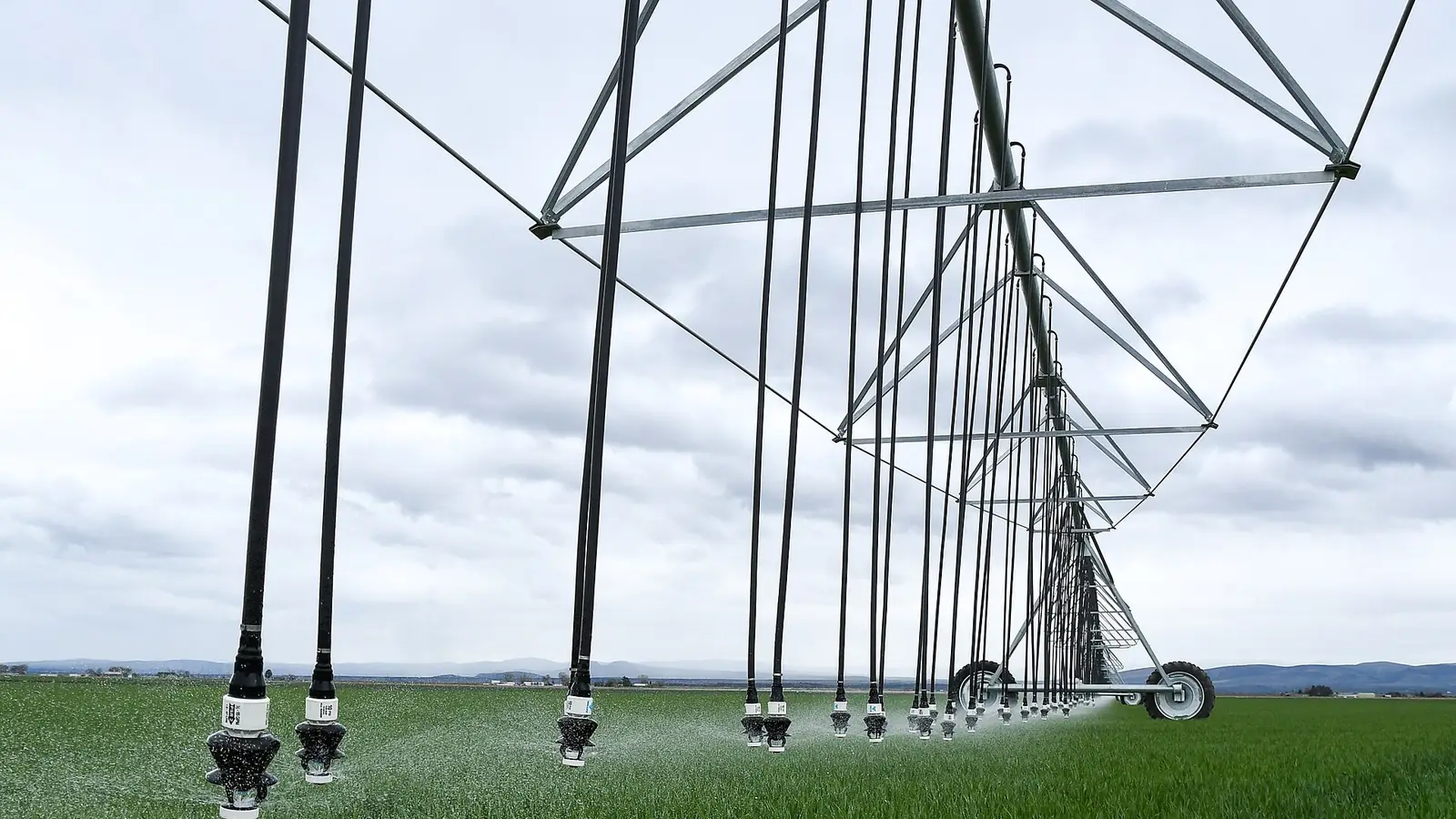
How a Micro Sprinkler Works
Micro sprinklers are scaled-down sprinklers: a small body or stake-mounted head with a nozzle or deflector that distributes 20–120 L/h over a 1–4 m radius at 1–3 bar. The family divides by how the water leaves the head:
| Type | Water exit | Flow | Radius | Typical use |
|---|---|---|---|---|
| Micro spray | Fixed fan/deflector pattern | 20–80 L/h | 1–2 m | Greenhouses, benches, propagation |
| Micro jet | Fine fixed jets from a small body | 20–60 L/h | 1.5–3 m | Nurseries, containers, tunnels |
| Spinning micro sprinkler | Rotating deflector or mini-rotor | 40–120 L/h | 2–4 m | Young orchards, under-tree watering |
| Fogger/mister | Very fine droplets | 5–20 L/h | 0.5–1.5 m | Propagation, cooling, humidity |
Because the flows and orifices are small (0.5–2 mm), micro irrigation is the most filtration-sensitive layer of the whole system — and the most rewarding when filtration is right: precision watering with almost no runoff, at pressures any small pump can supply.
Micro Spray vs Micro Jet vs Spinning Head: Selection
| Factor | Micro spray | Micro jet | Spinning micro sprinkler |
|---|---|---|---|
| Droplet size | Medium | Fine | Medium-large |
| Wind sensitivity | Moderate | High (fine jets drift) | Low (heavier droplets) |
| Uniformity | Good within pattern | Good | Excellent (rotating) |
| Clog tolerance | Moderate | Low (finest passages) | Better (larger passages) |
| Best for | Bench/table watering | Containers, tight rows | Orchards, under-tree, open beds |
The decision rule: benches and propagation → micro sprays or misters (fine, even, low flow); container nurseries → micro jets (precise, low flow per pot); orchards and field beds → spinning micro sprinklers (larger droplets, better wind resistance, wider radius). If you are watering young trees, the spinning head’s under-tree pattern keeps the trunk dry and wets the root zone — the standard for young orchard establishment.
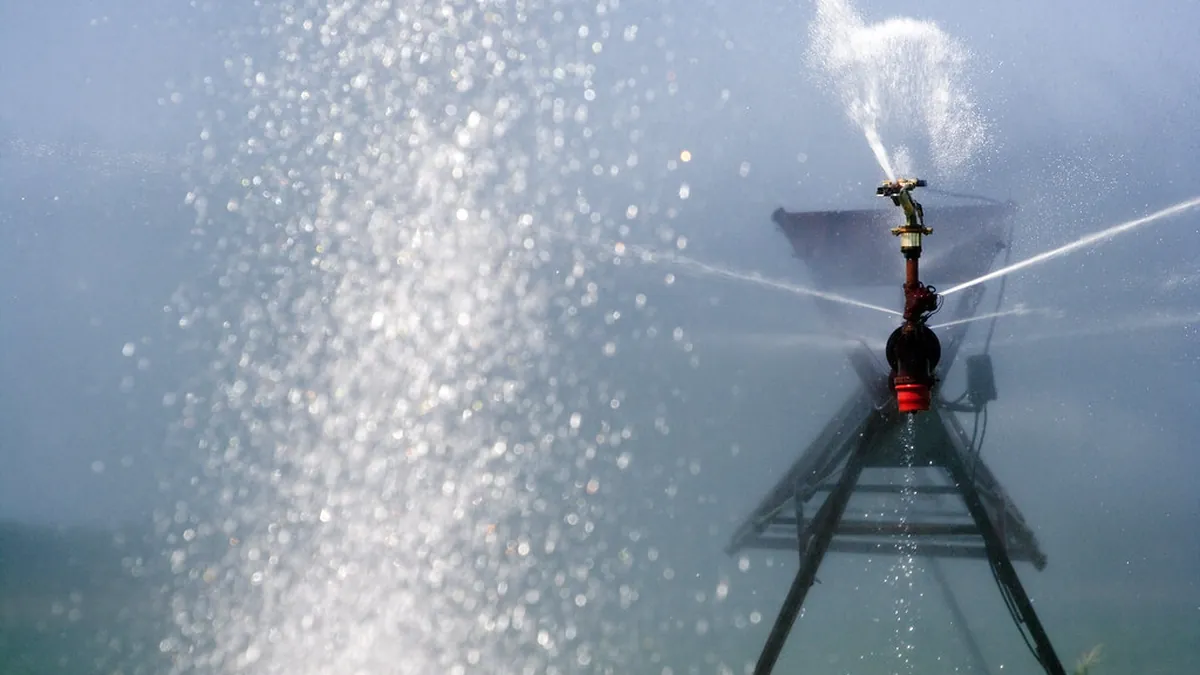
Micro vs Drip: Choosing the Precision Tool
| Factor | Micro sprinkler | Drip |
|---|---|---|
| Flow per point | 20–120 L/h | 0.5–8 L/h per emitter |
| Foliage wetting | Yes (overhead) | No (soil surface/sub-surface) |
| Water efficiency | Good | Highest |
| Germination/cooling | Yes | No (no overhead) |
| Clog risk | Medium (small orifices) | High (smallest orifices) |
| Coverage shape | Circular area | Line/point |
| Best for | Benches, young orchards, tunnels | Rows, permanent plantings, arid regions |
The practical split: drip where every litre counts and foliage must stay dry (permanent rows, arid regions, disease-sensitive crops); micro sprinklers where overhead wetting is wanted — germination, cooling, propagation, and young orchards where the root zone is still small and circular. Many systems run both: drip for the permanent crop, micro sprays for the propagation bench and the frost-protection layer.
Sizing and Design for Micro Systems
- Flow per head — from the crop need: a young citrus tree wants roughly 30–60 L/h in its establishment phase; a nursery bench row wants 40–80 L/h per metre of row, split across micro sprays.
- Pressure — design the lateral for the family band (1–3 bar). Micro systems are usually fed by a small pump or a pressure-reduced mainline; a pressure regulator at the zone valve (e.g. set at 2 bar) is the single best investment for consistent micro performance.
- Spacing — match the wetting radius to the plant spacing: under-tree micros at 1 per tree with a radius that covers the young root zone; bench micro sprays at spacing equal to ~60–70% of the wetting diameter for overlap.
- Filtration — 120–150 mesh (100–130 micron) filters at the system inlet, plus a flush valve at each zone end. If the water has algae or silt, step filtration up, not the nozzles down.
- Fertigation compatibility — micro systems inject well, but always inject fertilizer upstream of the filter and flush after injection cycles, or precipitates will build in the fine orifices.
Clogging Prevention: The Micro System’s Whole Game
Clogs are the #1 micro system failure, and prevention is a four-part routine:
- Filter right — 120–150 mesh at the inlet, cleaned on a schedule (weekly in algae season).
- Flush the lines — open zone end flush valves at startup and after fertigation until water runs clear.
- Clean, don’t poke — a clogged micro nozzle is cleaned by soaking in a mild acid solution (e.g. 0.5% citric acid) or replacing the nozzle; poking with wire enlarges the orifice and ruins the pattern.
- Watch the pressure — a drop across the zone means a blocked lateral or filter, not “the pump is weak.” Pressure gauges at zone inlets turn a season of mystery clogs into a 5-minute diagnosis.
Winter: drain micro lines thoroughly — the smallest water pocket freezes into the biggest crack in a 2 mm orifice.
Applications by Crop
| Application | Head choice | Notes |
|---|---|---|
| Propagation (cuttings, seed) | Fogger/mister or fine micro spray | 5–20 L/h, frequent short cycles |
| Greenhouse benches | Micro spray | Even coverage, low flow |
| Container nurseries | Micro jet | One jet per pot or per few pots |
| Young orchards | Spinning micro sprinkler | Under-tree pattern, trunk dry |
| Tunnel/row crops | Micro spray or jet | Foliage wetting for cooling |
| Frost protection (light) | Micro sprinkler overhead | Small orchards, tunnels |
Micro sprinklers are also the go-to for germination and heat-stress cooling: short overhead cycles wet the foliage and the soil surface, dropping leaf temperature and keeping seedlings hydrated without the runoff of a full-size head.
Micro vs Other Low-Flow Methods
Micro sprinklers share the “low-flow” shelf with two other tools, and the boundaries matter:
| Method | Flow per point | Wetting | Foliage | Best for | Weakness |
|---|---|---|---|---|---|
| Micro sprinkler | 20–120 L/h | Circular area | Wets foliage | Benches, young orchards, tunnels | Clog-prone small orifices |
| Drip line | 0.5–8 L/h per emitter | Line/point | Stays dry | Rows, permanent crops, arid zones | No overhead wetting |
| Soaker hose | ~2–6 L/h per metre | Band under the hose | Stays dry | Garden beds, small plots | Poor uniformity on slopes, short life |
Soaker hoses are the low-cost entry tool — fine for a kitchen garden, wrong for a nursery bench where every pot needs the same water. Drip is the efficiency champion where foliage must stay dry and water is scarce. Micro sprinklers are the middle tool with one unique capability: overhead wetting at low flow, which drip and soaker cannot do. When the crop needs leaf wetting (germination, cooling, frost protection in tunnels), micro sprinklers are the only low-flow option.
A second boundary worth naming is micro sprinklers vs full-size sprinklers. A full-size impact at 3 bar delivers 600–2,000 L/h over 12–18 m — a micro sprinkler at the same pressure delivers 20–120 L/h over 1–4 m. The micro head’s advantage is precision and pressure economy: a 0.8 m³/h zone can run off a small pump or a pressure-reduced mainline, while the same area with full-size heads needs real hydraulics. The cost of that precision is per-point complexity — more heads, smaller orifices, stricter filtration. Choose the smallest head that covers the space; choose the largest orifice within that head’s family.
Worked Case: A Nursery Bench Retrofit
A container nursery ran 12 benches of young ornamentals on overhead full-size sprinklers — 40 minutes per cycle, foliage constantly wet, and roughly 30% of the water landing on the aisles. The retrofit plan: replace the overhead zone with micro sprays at 40 L/h, one per 1.2 m of bench, two benches per zone.
The numbers that sold the change:
- Water: the overhead zone used 12 m³ per cycle; the micro zones use 4.3 m³ (20 heads × 40 L/h × 2 benches per zone = 1.6 m³/h per zone; 40 minutes per cycle at the same frequency ≈ 4.3 m³ total). 64% less water per cycle.
- Uniformity: bench-to-bench variation dropped from roughly ±25% (aisle overspray and edge effects) to ±10% — measurable in faster, more even rooting.
- Foliage: the fine micro spray still wets foliage for heat-stress cooling during summer, but the 6–7 pm overhead drenching that had been keeping foliage wet overnight was gone — a visible drop in the nursery’s fungal leaf-spot incidents over two seasons.
- Pressure: the whole retrofit ran off the existing mainline at 2 bar, no booster, no new sub-main beyond a DN20 lateral per bench row.
The retrofit paid for itself in the first season on water and labour (no more manual aisle overspray cleanup), and the nozzle kit became the standing reorder — 240 micro nozzles a year across the 12 benches. It is the standard story for micro systems: small heads, small flows, small bills — and a repeat-parts line the grower orders without thinking.
Buying Micro Sprinklers Factory-Direct and OEM
Micro lines are a distributor favorite because the repeat cycle is fast and the SKU count is small: a body family (stake, spike, and inline micro sprays/jets), color-coded or size-marked nozzles, and connectors. Factory-direct supply points:
- Filtration-matched orifice sizes — the supplier should publish the orifice size per flow rating so you can match filtration recommendations
- Compatibility matrix — which body takes which nozzle at which flow/pressure
- Low trial MOQ — a micro kit is cheap to stock, and the nozzle/deflector reorders are the repeat line
- OEM branding — bodies, stakes, nozzles and packaging in private label
This is the model IRRIGRAIN supports across the sprinkler range, including micro: factory-direct micro sprays, jets and spinning heads with matched nozzles, OEM tooling and low trial MOQs for distributor programs.
The Bottom Line
Micro sprinklers win by being small and precise: low pressure, low flow, and a wetting pattern shaped to the crop. Choose the family by droplet and radius (spray for benches, jet for pots, spinning for orchards), protect the small orifices with real filtration, and the micro layer delivers the most consistent watering in the whole system. Skimp on filtration and it delivers the most frustrating clogs instead.
If you are building a micro irrigation line for a nursery, greenhouse or orchard program — send your target flows, pressures and packaging requirements. IRRIGRAIN will spec the micro range, factory-direct.
Appendix A: Micro Selection Reference
Indicative design bands for the micro family. Verify every figure against the exact model’s spec sheet.
| Head type | Flow (L/h) | Pressure (bar) | Radius (m) | Orifice (mm) | Best fit |
|---|---|---|---|---|---|
| Fogger / mister | 5–20 | 1.5–2.5 | 0.5–1.5 | 0.5–0.8 | Propagation, humidity, cooling |
| Micro spray | 20–80 | 1.5–2.5 | 1–2 | 0.8–1.5 | Greenhouse benches, seed beds |
| Micro jet | 20–60 | 1–2 | 1.5–3 | 0.8–1.2 | Containers, pots, tight rows |
| Spinning micro sprinkler | 40–120 | 1.5–3 | 2–4 | 1.2–2 | Young orchards, under-tree, field beds |
The orifice column is the filtration story: a 0.8 mm fogger orifice is clogged by a particle a 2 mm spinning-head orifice would pass. Choose the head with the largest orifice that still gives the pattern you need, and filter to match the smallest orifice in the zone.
Appendix B: Micro System Design Math
Sizing a micro zone is flow budgeting, not sprinkler math. Worked example — a nursery bench 24 m long with micro sprays every 1.2 m, each flowing 40 L/h:
Heads per bench row = 24 ÷ 1.2 = 20 heads Zone flow = 20 × 40 = 800 L/h = 0.8 m³/h
On a 2 bar zone pressure, 0.8 m³/h needs a lateral of DN16–DN20 (or 13–16 mm) for acceptable friction loss under 10%. Now the same logic on a young orchard — 120 trees at 50 L/h each with a spinning micro under every tree:
Zone flow = 120 × 50 = 6,000 L/h = 6 m³/h
Six m³/h is a real flow: it needs a DN32–DN40 sub-main, a zone valve sized for 6 m³/h, and a filter rated above that flow (a 120-mesh disc filter at 6 m³/h is roughly a 2-inch unit). The error that kills micro zones is undersizing the sub-main — the friction loss then starves the far heads, and the “clogged” diagnosis is actually a pressure problem 50 m away.
Appendix C: Clog Diagnosis Table
| Symptom | Likely cause | Fix |
|---|---|---|
| One head dry, others fine | Blocked nozzle or emitter | Soak in 0.5% citric acid; replace if still blocked |
| A row of heads weak | Blocked lateral or end cap missing flush | Flush the line at the end valve |
| Zone-wide low flow | Clogged filter or undersized sub-main | Clean filter; check friction loss design |
| Droplet size shrinks (mist) | Orifice partially eroded or pressure too high | Replace nozzle; verify zone pressure |
| Intermittent blockages | Algae or sediment in source | Upgrade filtration; add flush schedule |
| Heads leak at the body | Worn seal or loose connection | Replace seal; re-tighten connection |
The pattern: a single dry head is a nozzle problem; a row is a line problem; the whole zone is a filter or design problem. Diagnose at the right level and the fix is minutes instead of an afternoon of nozzle-poking.
Appendix D: Seasonal Micro Checklist
Spring startup:
- Flush every zone end until water runs clear
- Replace any nozzles that were poked or enlarged last season
- Verify zone pressures at 1–3 bar; adjust regulators
- Confirm filter mesh matches the smallest orifice in the zone
Mid-season (weekly in algae season, monthly otherwise):
- Clean the filter on schedule — not when flow drops
- Walk one row per zone looking for dry heads and misting (erosion) patterns
- Flush after every fertigation cycle
Season end:
- Drain all micro lines thoroughly (freeze = cracked orifices)
- Note heads that clogged repeatedly — they mark filtration or water-quality issues to fix before next season
- Order the next season’s nozzle/deflector kit from the zone log
Appendix E: Fertigation and Micro — Doing It Safely
Micro systems fertigate well because the flows are low and the distribution is even — but the fine orifices turn fertilizer chemistry into a clog risk. The safe routine:
- Inject upstream of the filter — the filter catches any precipitate before it reaches the heads
- Flush after injection — run clear water for 5–10 minutes after each fertigation event
- Match fertilizer to the water — avoid injecting fertilizers that precipitate with your source water chemistry (e.g. calcium + phosphate in hard water); a simple solubility check prevents most buildup
- Acid-clean on schedule — a seasonal 0.5% citric acid soak of blocked nozzles, or a low-dose acid injection for heavily scaled systems
Fertigation is where micro irrigation pays its biggest dividend — precise, frequent, low-volume feeding — and also where the most clogs are born. The upstream-of-filter rule plus the post-injection flush removes 90% of that risk.
- Micro Sprinkler — low-flow micro sprays, jets and spinning heads
- Sprinkler Nozzle Guide — sizing, color codes and replacement
- Impact Sprinkler Guide — full-size heads for open-field duty
Frequently Asked Questions
What is a micro sprinkler?
A micro sprinkler is a low-flow, low-pressure sprinkler head that delivers 20–120 L/h over a 1–4 m radius, typically operating at 1–3 bar. It bridges drip irrigation (very low flow) and full-size sprinklers, watering small areas precisely.
What pressure do micro sprinklers need?
Most micro sprinklers operate at 1–3 bar. Micro sprays run best at 1.5–2.5 bar, micro jets at 1–2 bar, and micro sprinklers with spinning deflectors at 1.5–3 bar. Higher pressure increases misting and wind drift.
How far can a micro sprinkler throw water?
Typical micro sprinklers throw 1–4 m radius depending on model and flow. Low-flow micro sprays cover 1–2 m, micro jets 1.5–3 m, and higher-flow micro sprinklers reach 3–4 m.
What is the difference between micro sprinklers and drip irrigation?
Drip delivers water at the soil surface or below through emitters (0.5–8 L/h per emitter) with no wetting of the foliage. Micro sprinklers spray water over a small area, wetting foliage and a wider soil surface — useful for germination, cooling, and crops that need overhead wetting, but less water-efficient than drip.
Do micro sprinklers clog easily?
Yes — their small orifices (0.5–2 mm) are the most clog-prone part of an irrigation system. Filtration to 120–150 mesh (or 100–130 micron) is standard, and flushing the lines at startup and after fertilizer injection prevents most blockages.
Are micro sprinklers good for orchards?
Yes, especially for young orchards and under-tree micro-sprinkler systems. A micro sprinkler under each tree delivers 30–120 L/h to the root zone, keeps the trunk dry, and can be converted to full-circle or part-circle patterns as the tree grows.