How to Adjust an Impact Sprinkler: Range, Arc and Pattern
2026-08-26
How to Adjust an Impact Sprinkler: Range, Arc and Pattern
An impact sprinkler that throws water onto the road instead of the crop, or leaves a dry strip at the edge of the field, is wasting both water and pump hours. The good news: nearly every impact head gives you three mechanical controls — range, arc and pattern — and tuning all three takes about ten minutes per head once you know the order to work in. This guide walks through the adjustment sequence step by step, from the pressure check to the coverage test.
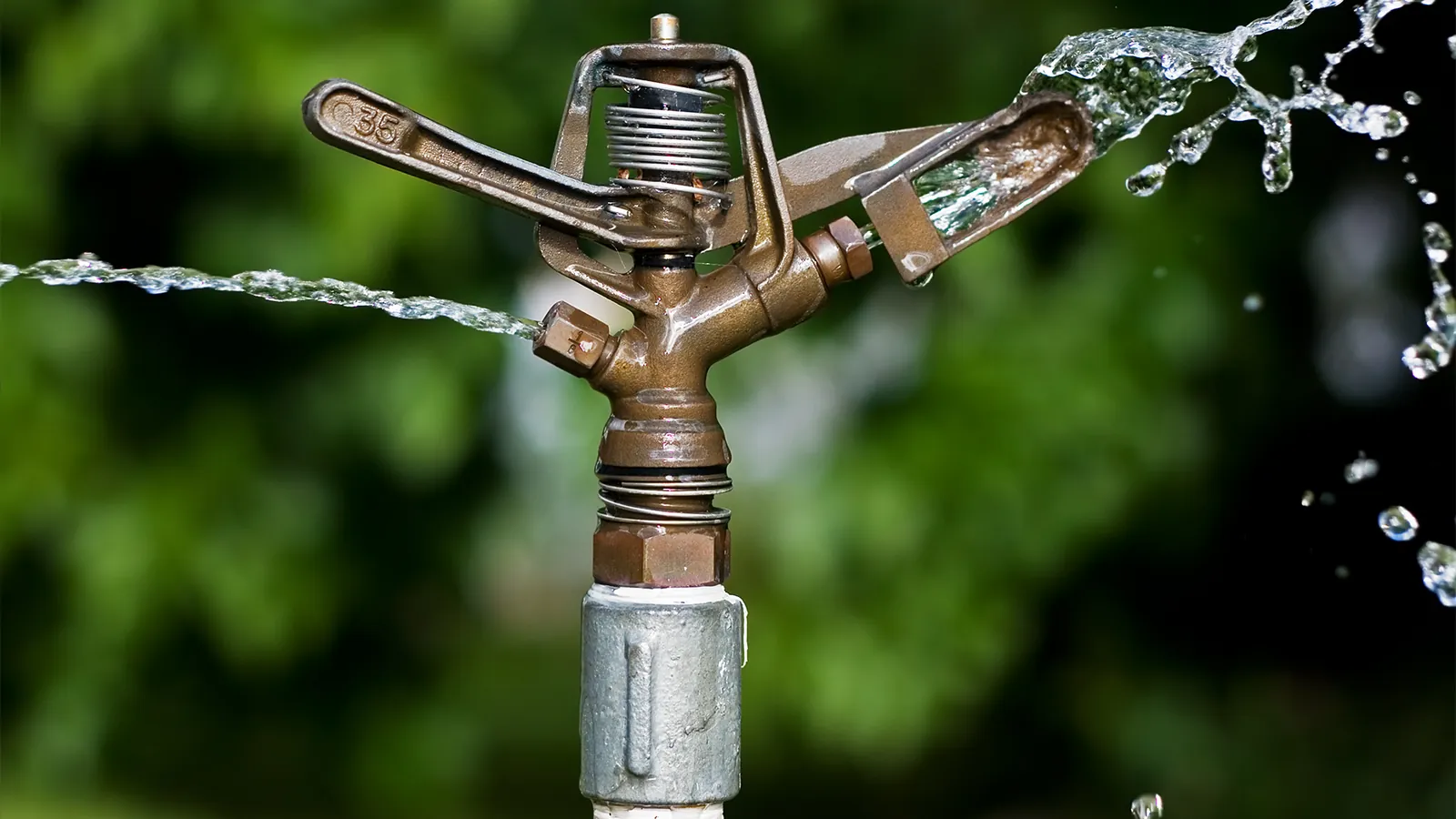
The Snapshot
- Three adjustments on most impact heads: range (diffuser pin), arc (part-circle collar, 20°–340°) and pattern (nozzle size + deflector angle)
- Operating window: 2.5–5 bar; typical agricultural throw 12–18 m
- Work order matters: pressure → arc → range → pattern → rotation → verify
- Verify with catch cups and the 50–65% of wetting diameter spacing rule
- No special tools needed: adjustable wrench, flat-head screwdriver, pressure gauge, catch cups
What You Can Adjust on an Impact Sprinkler
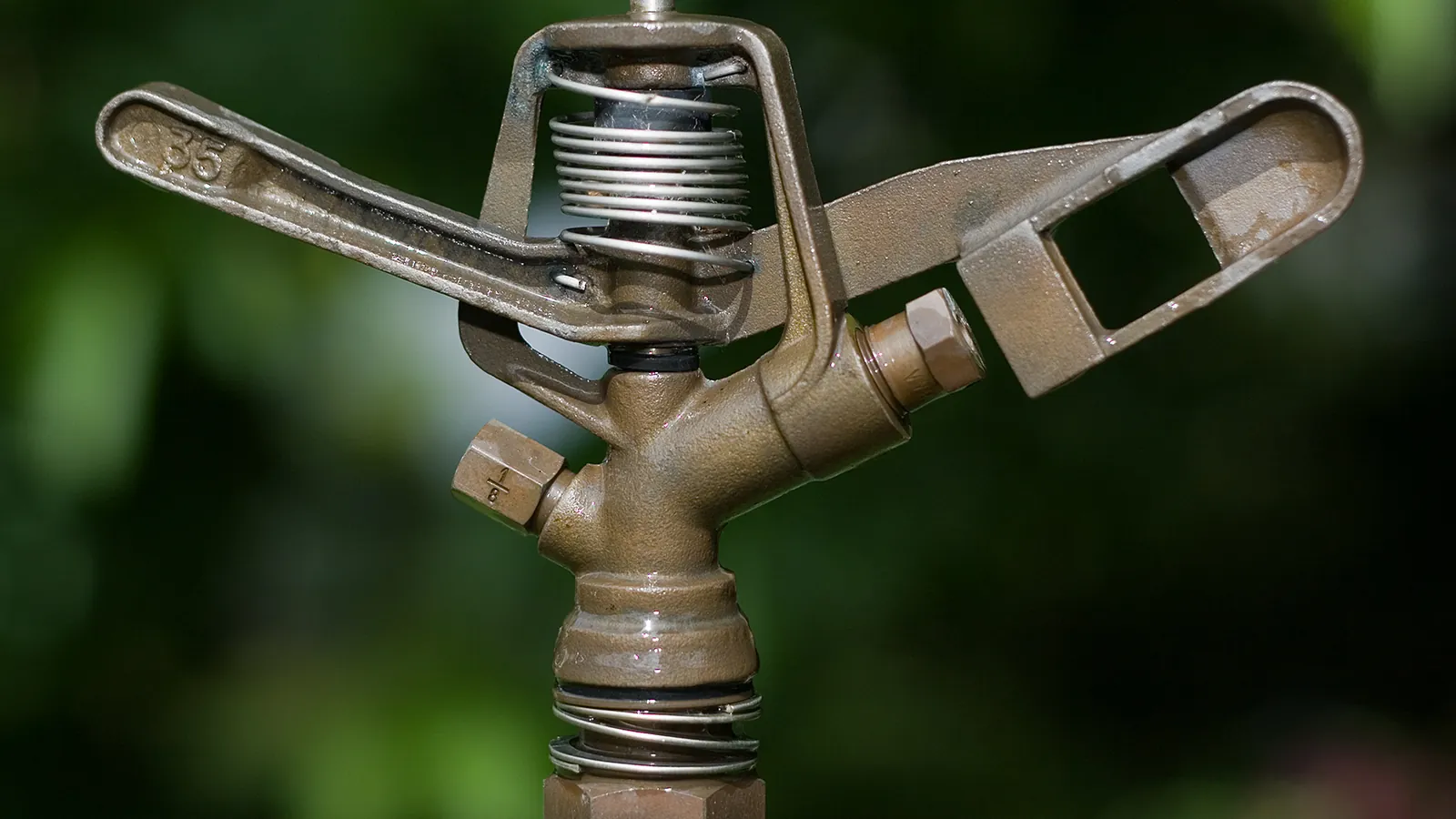
Impact heads are simple machines: a spring-loaded arm is struck by the water stream and nudges the body forward a few degrees per pulse. That design gives you four independent controls:
| Control | What it does | Typical range |
|---|---|---|
| Diffuser pin | Interrupts the stream to shorten throw and break up droplets | Full stream → fully diffused |
| Part-circle collar | Limits the sweep angle | 20°–340° (full circle = 360°) |
| Nozzle size | Sets flow rate, droplet size and throw | 2–14 mm orifice (model-dependent) |
| Deflector plate angle | Tilts the stream for distance vs. fineness | Fixed or adjustable per model |
Step 1: Check Operating Pressure First
Adjusting anything before confirming pressure is wasted effort. Attach a pressure gauge at the riser or head inlet and run the zone. Most agricultural impact sprinklers are designed for 2.5–5 bar. Below roughly 2 bar, the stream loses coherence, throw drops sharply and rotation turns erratic; well above the rated range, droplets shatter into fine mist that drifts off target and evaporates before reaching the soil. If pressure is outside the window, fix the pump, valve or pipe size issue before touching the head.
Step 2: Set the Range with the Diffuser Pin
The diffuser pin — also called the spreader or deflector pin — sits in the path of the water stream just past the nozzle.
- Push the pin down into the stream: the stream breaks up, throw shortens and droplets get finer. This is how you protect young seedlings or keep water inside a narrow bed.
- Pull the pin up out of the stream: full stream, maximum range and larger droplets, typically 12–18 m at 2.5–5 bar on standard agricultural models.
On most heads the pin is spring-loaded and clicks into position. Make adjustments in small increments — a quarter of the pin travel changes throw by a couple of metres — and note that a deeply diffused stream carries less impact energy, which slows rotation.
Step 3: Set the Arc with the Part-Circle Collar
On part-circle models, a collar or trip ring on top of the body limits the sweep, typically between 20° and 340°. Loosen or rotate the collar to the segment you want, then lock it. Practical tips:
- Set the arc before the diffuser pin — range changes alter impact energy and therefore rotation speed, which shifts where the head stops.
- Aim the fixed trip tab at the edge of the crop block so water lands inside the field, not on the road or fence line.
- For corners and headlands, use narrow part-circle settings (60°–90°) instead of letting a full-circle head overshoot.
Step 4: Tune the Spray Pattern with Nozzle and Deflector
Pattern means two things: droplet size and stream shape.
- Nozzle size drives flow. A larger orifice passes more water, giving bigger droplets and a longer throw at the same pressure; a smaller orifice does the opposite. Match nozzle flow to pump capacity and pipe size — an undersized line starves every head downstream. Swap nozzles with the head off or the zone shut down, and keep a spare nozzle set on the truck.
- Deflector plate angle tilts the stream: a flatter angle throws farther with larger droplets, a steeper angle throws shorter with finer coverage. Adjust it only if your model has a screw-locked plate; otherwise leave it at the factory position.
Step 5: Adjust Rotation Speed and Consistency
Rotation should be steady — a slow, even pulse, not a stall-and-jerk cycle. If the head creeps, stops mid-arc or spins too fast to distribute water evenly:
- Check spring tension on the trip arm if the model has an adjusting screw; too little tension weakens the pulse, too much makes the arm slap without advancing.
- Confirm the head is level — a tilted body biases the arc and uneven wear on the bearing.
- Clean the bearing and pivot area of grit and debris; a stiff bearing is a common reason heads stop at the same point every cycle.
Step 6: Test Coverage and Verify Uniformity
Run the zone for 20–30 minutes and check the wetting pattern. Place catch cups in a line from the head outward, or simply watch where the water lands:
- Dry ring near the head: diffuser is set too deep, or nozzle/deflector angle needs adjustment.
- Water past the crop edge: arc is overshooting its segment — narrow the collar.
- Visible stripes between heads: spacing exceeds the 50–65% of wetting diameter rule for your throw radius.
Re-adjust in small steps and re-test once. When a setting works, mark the collar and pin positions — repeatability matters when you have 40 identical heads in a block.
Common Adjustment Issues and Fixes
| Symptom | Likely cause | Fix |
|---|---|---|
| Head not rotating | Low pressure, weak spring, stiff bearing | Check 2.5–5 bar; tension spring; clean bearing |
| Water lands on road/fence | Arc too wide or mis-aimed | Narrow collar; re-aim trip tab |
| Dry strip near head | Diffuser too deep; oversized nozzle | Raise pin; downsize nozzle |
| Fine mist drifting away | Pressure too high for nozzle | Reduce pressure or upsize nozzle |
Frequently Asked Questions
How do you adjust the range on an impact sprinkler? Push the diffuser pin into the stream to shorten the throw and create finer droplets; pull it up for the full stream and maximum range (12–18 m at 2.5–5 bar).
How do you set the arc on a part-circle impact sprinkler? Rotate the part-circle collar to the desired sweep (typically 20°–340°) and lock it. Set the arc before adjusting the diffuser pin.
What pressure do impact sprinklers need to work properly? 2.5–5 bar for most agricultural models. Below about 2 bar, throw and rotation suffer; above the rated range, drift and evaporation increase.
How does nozzle size affect the spray pattern? Bigger orifice = more flow, larger droplets, longer throw. Smaller orifice = finer droplets, shorter throw. Match nozzle flow to pump and pipe capacity.
Why is my impact sprinkler not rotating evenly? Check inlet pressure, then trip spring tension and bearing condition. Debris in the bearing or a bent trip arm are common causes.
Factory-Direct Support and OEM Orders
Every IRRIGRAIN impact sprinkler is built for field service — replaceable nozzles, springs and seals, and adjustments that hold their setting season after season. Buying factory-direct means you spec the nozzle set, body material and arc configuration at the source, and OEM orders support custom nozzles, colours and private labelling. For pricing, samples or a configuration sheet, email cj226144@gmail.com — we answer with specifications and lead times, ready for your next irrigation project.
Frequently Asked Questions
How do you adjust the range on an impact sprinkler?
Push the diffuser pin down into the water stream to shorten the throw and break the stream into finer droplets; pull it up to restore the full stream and maximum range (typically 12–18 m at 2.5–5 bar).
How do you set the arc on a part-circle impact sprinkler?
Rotate the part-circle collar or trip ring on top of the sprinkler body to the desired sweep, typically 20°–340°. Set the arc before adjusting the diffuser pin, because stream changes affect impact energy and rotation.
What pressure do impact sprinklers need to work properly?
Most agricultural impact sprinklers operate at 2.5–5 bar. Below roughly 2 bar the throw collapses and rotation becomes erratic; above the rated range, droplets shatter into fine mist that drifts off target.
How does nozzle size affect the spray pattern?
A larger nozzle passes more flow, producing bigger droplets and a longer throw at the same pressure. A smaller nozzle gives finer droplets and a shorter throw. Match nozzle flow to your pump capacity and pipe size.
Why is my impact sprinkler not rotating evenly?
Check inlet pressure first (2.5–5 bar), then the trip spring tension and arm travel, then the bearing. Debris in the bearing or a bent trip arm are common causes; clean, straighten or replace the part.
Can I get impact sprinklers with custom nozzles or branding?
Yes. As a factory-direct manufacturer we support OEM orders with custom nozzle sizes, body materials, colours and private labelling. Email cj226144@gmail.com for a quote.