Rotary Sprinkler Guide: Gear-Driven Heads, Selection and Applications
2026-08-25
A rotary sprinkler that stalls mid-circle leaves a dry wedge in the field every single pass — and the cause is almost never the sprinkler. It is pressure, nozzle, or water quality, in that order. Rotary (gear-driven) heads are the quiet, precise workhorses of modern irrigation, but they have a narrower operating envelope than the impact heads they often replace.
This guide covers how gear-driven rotors actually work, the real trade-offs against impact and stream-rotor types, sizing and spacing rules, and where rotors genuinely win in agriculture.
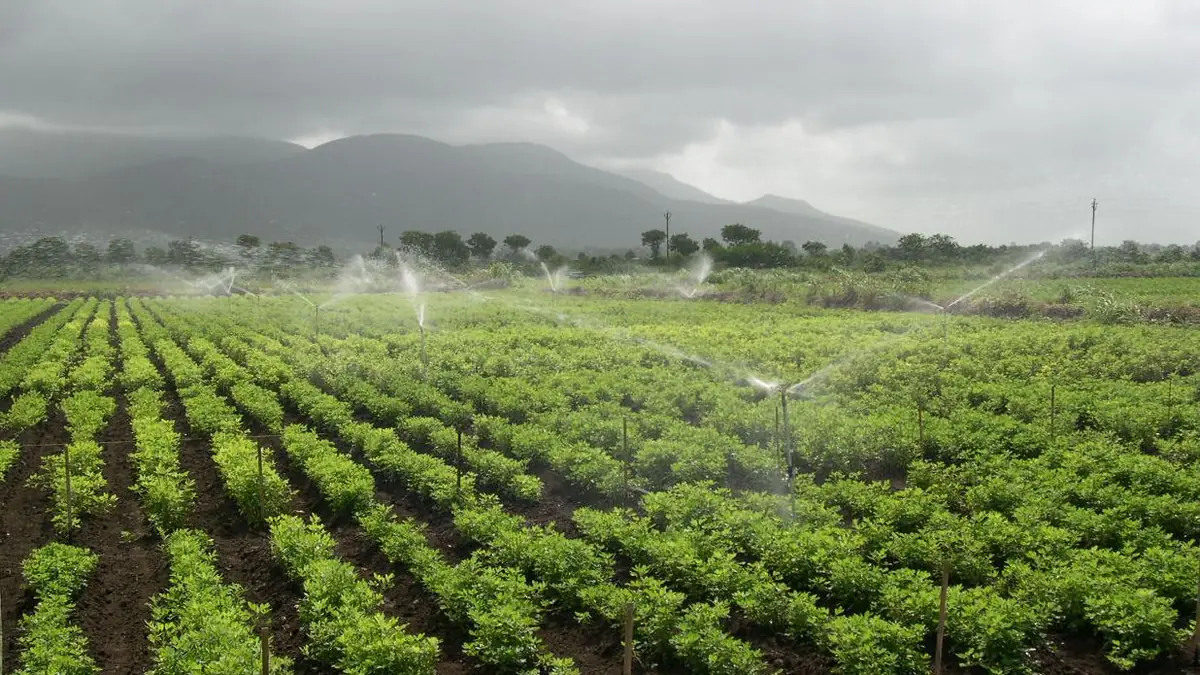
How a Gear-Driven Rotary Sprinkler Works
Inside a gear-driven rotor, the water jet passes a small turbine (or drive vane) before exiting the nozzle. The turbine spins a gear train that slowly rotates the sprinkler body — typically one full revolution every 30 seconds to several minutes, depending on the model and the gear ratio.
Three consequences follow from that design:
- Rotation is smooth and constant — no hammering arm, no pulse. The jet sweeps the circle at a steady angular speed, which is what produces high uniformity.
- Rotation speed is set by flow, not by pressure spikes — the same nozzle/gear combination rotates at roughly the same speed across the pressure band, so precipitation stays even as pressure fluctuates.
- The drive mechanism sits in the water path — fine passages (turbine, gears, nozzle) mean the head needs clean water. Sand and silt are the rotor’s enemy.
The precipitation rate of a rotor is low and even: typical gear-driven agricultural rotors deliver 8–15 mm/h, versus 15–30 mm/h for many impact layouts at the same spacing. Low precipitation rate matters because it gives the soil time to absorb — less runoff on slopes and in heavy soils.
Types of Rotary Sprinklers
| Type | Drive | Radius | Best fit |
|---|---|---|---|
| Gear-driven rotor (agricultural) | Turbine + gears | 9–25 m | Orchards, vineyards, nurseries, row crops |
| Gear-driven rotor (turf) | Turbine + gears | 4–15 m | Golf, sports fields, parks |
| Stream rotary | Rotating multi-stream plate | 4–10 m | Landscape, medium turf, low flow |
| Rotary impact | Spring-arm pulse (impact family) | 12–30 m | Dirty water, open field, frost protection |
The naming confusion is worth clearing: “rotary” in the industry can mean gear-driven rotors, stream rotors, or the rotary-action impact heads. A gear-driven rotor and a rotary impact head are different mechanisms with different water-quality tolerance. When a spec says “rotary sprinkler,” confirm the drive type.
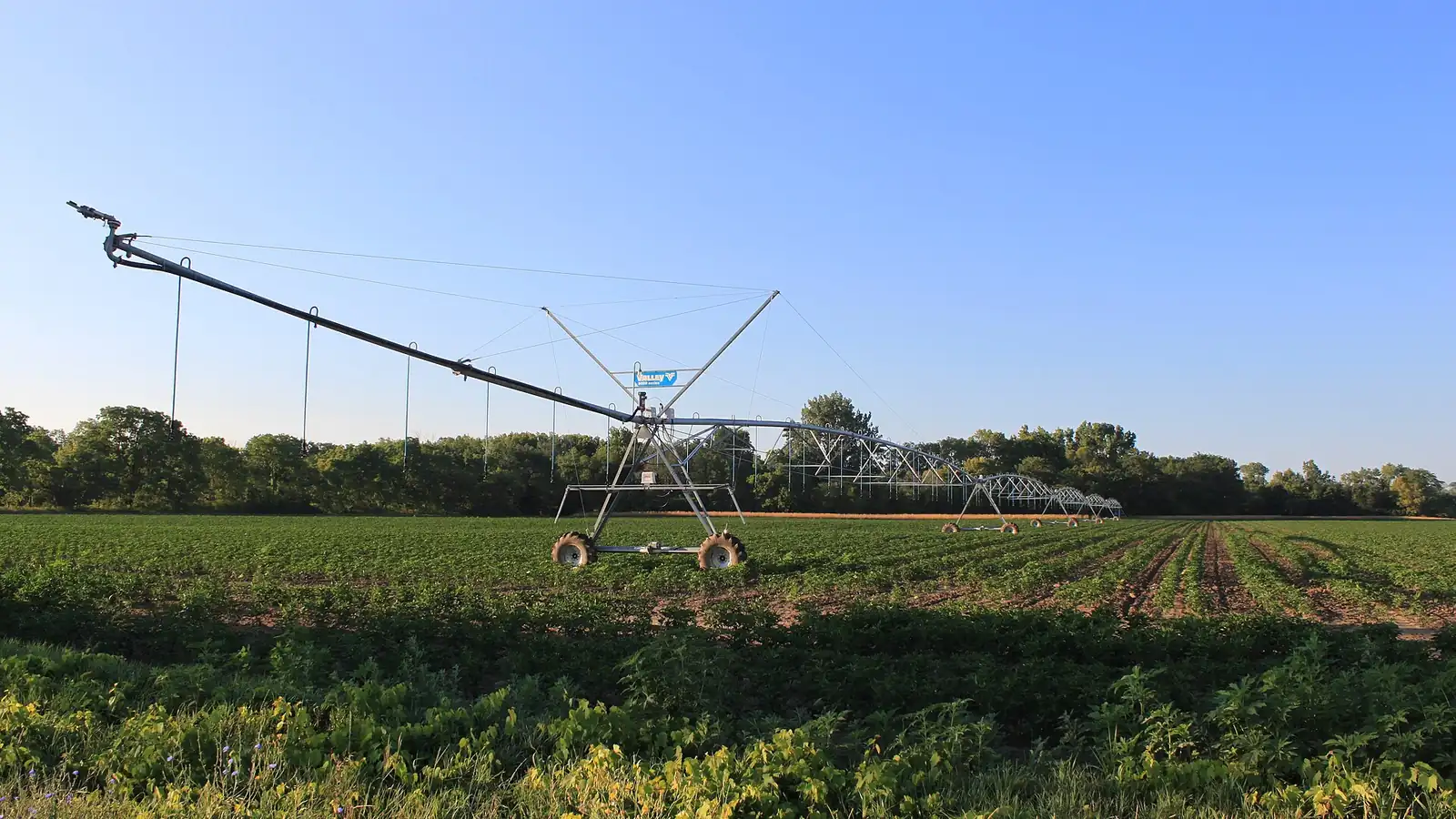
Rotary vs Impact: The Real Trade-offs
| Factor | Gear-driven rotor | Impact |
|---|---|---|
| Uniformity | Excellent — smooth constant rotation | Good — pulse rotation, more wind-sensitive |
| Precipitation rate | Low (8–15 mm/h) — absorbs well | Higher (15–30 mm/h) — runoff risk on slopes |
| Water quality | Needs clean water (fine passages) | Tolerates sand, silt, reclaimed water |
| Noise | Quiet | Loud hammering — noticeable at night |
| Wind resistance | Moderate — finer stream breaks up | Good — large droplets, low drift |
| Maintenance | Replace nozzles, flush body | Replace nozzle, spring, arm bushings |
| Cost | Higher | Lower |
| Frost protection | Not typical | Yes — impacts are the standard frost head |
The decision rule used by most irrigation consultants: clean water + uniformity-sensitive crop (orchards, vineyards, nurseries) → gear-driven rotors; dirty water or open-field wind exposure → impact heads. In frost protection, impacts remain the default because they move large volumes of water in large droplets.
Sizing and Selecting a Rotary Sprinkler
Selection follows five steps:
- Set the radius from field geometry — measure the block dimensions and pick the rotor radius that keeps spacing within the 50–65% wetted-diameter rule (e.g. a 15 m radius rotor at 50% = 15 m spacing).
- Check the pressure at the head — gear-driven rotors need their design band (typically 2.5–4.5 bar); below the minimum the rotor stalls. This is the #1 rotor failure, and it is a system design fault, not a sprinkler fault.
- Choose the nozzle set — the spec sheet gives nozzle K values and the throw at each pressure. Use the flow-pressure math (Q = K × √P) to hit the block’s irrigation requirement.
- Verify precipitation rate — for the chosen spacing, PR = flow ÷ area. Keep it within the soil’s intake rate to avoid runoff.
- Confirm water quality — if the supply is sandy or reclaimed, step up filtration or step back to impacts.
Spacing and Uniformity Rules
The 50–65% of wetted diameter spacing rule applies to rotors as to every mechanical head. Two refinements for rotors:
- Windy sites: space tighter (50%) — the stream is finer than an impact’s, so drift costs more uniformity.
- High-value crops: use the square spacing at 50–55% — the uniformity gain pays for the extra heads in yield terms, and rotor spacing is cheap compared with the crop.
When spacing changes, the nozzle flow must change with it to keep the same irrigation depth: halving the spacing quarters the area per head, so each head needs a quarter of the flow for the same mm/h.
Agricultural Applications
| Application | Why rotors win | Notes |
|---|---|---|
| Orchards | Low PR soaks root zones, no runoff on orchard floors | Full-circle or part-circle rotors between rows |
| Vineyards | Even coverage, quiet night operation | Watch trellis shadow on low heads |
| Nurseries | Precise low flows, container-friendly | Micro-rotors for greenhouse benches |
| High-value row crops | Uniformity drives yield | Clean water required |
| Turf/golf/parks | Silent, uniform, aesthetic | The classic rotor stronghold |
Rotors also pair well with drip-micro irrigation in mixed systems: rotors cover the mid-size area between drip lines and big impacts, giving the designer a third gear of precipitation control.
Rotary Sprinklers in Golf and Large Turf
Golf is where the gear-driven rotor earned its reputation, and the numbers show why. An 18-hole course typically covers 55–75 hectares; a regulation fairway is roughly 25–35 m wide and 250–400 m long; greens run 400–800 m². The irrigation designer splits that into zones with different precipitation targets — greens need the highest uniformity (DU above 85%) and the lowest precipitation rate (typically 4–8 mm/h) to avoid runoff on slopes and bowl contours, while fairways run 6–10 mm/h and roughs can drop to 4–6 mm/h with wider spacing.
Three rotor-specific practices dominate turf work:
- Part-circle discipline. Greens and tees are irregular shapes, so part-circle rotors (90°–330°) with matched nozzles cover the boundary without overspray. The nozzle key alignment matters here more than anywhere — a 180° error on a green edge floods a bunker lip all season.
- Head-to-head coverage at the boundary. Turf specifiers tighten spacing to 50% of the wetted diameter on greens because the eye sees a dry spot on a green faster than a farm notices a streak in a field. Tight spacing with low-flow nozzles keeps the PR under the soil intake rate of sand-based greens (which can actually take 20–40 mm/h, so greens are rarely runoff-limited — uniformity is the real goal).
- Night operation. Rotors’ quiet gear drive is the reason courses can run irrigation at night without complaints. An impact hammering through a residential boundary is a noise complaint waiting to happen; a rotor at 3–4 bar is barely audible at 20 m.
Sports turf (football, rugby, cricket) applies the same logic with one twist: the field is a single uniform surface, so full-circle or matched part-circle rotors at 50–60% spacing, running at 6–10 mm/h, with the schedule tuned to match maintenance windows. The selection, spacing and nozzle math is identical to the agricultural rules in this guide — the only differences are the uniformity target and the tolerance for overspray.
Maintenance That Prevents the Two Classic Failures
The two rotor failures that dominate call-outs are both preventable:
- Stall (head not rotating) — check head pressure against the rotor’s minimum, then the nozzle (worn or blocked nozzles cannot drive the turbine), then flush the body of debris. Most stalls are pressure, and most pressure problems are friction or lift losses in the lateral.
- Uneven rotation / hunting — worn nozzle, mineral buildup in the turbine, or a damaged gear train after a freeze. Clean, replace the nozzle, and if it still hunts, swap the drive assembly.
Seasonal practice: flush laterals at spring startup, replace nozzle sets on the 2-year rotation (sooner in sandy water), and verify one head per block with a pitot gauge. That hour of checks protects the season’s uniformity.
Pressure-Regulated Rotors and the Economics of Uniformity
Pressure-regulated rotors — the design popularized by Senninger and now common across the industry — hold a constant outlet pressure across a range of inlet pressures (typically ±0.2 bar from the regulated setpoint over a 2–5.5 bar inlet band). On a pivot or a long lateral where head pressure varies by 1–1.5 bar from the first to the last head, a regulated rotor keeps the nozzle at its design pressure, so every head throws the same radius and the same flow.
The economics are easy to quantify. Uniformity and water use move together: a system at 70% DU applies roughly 1.4× the target depth to the wetter half to cover the dry spots — 40% more water and pumping energy than a system at 85% DU. On a block pumping 100 m³/h for 1,200 hours a season at 0.15 USD/kWh with 0.6 kWh per m³ pumped, that excess is about 48,000 m³ of water and ~17,000 USD of pumping cost per season. Regulated rotors, honest spacing and matched nozzles are the cheapest route to that 15-point DU gain — cheaper than a new pump, a bigger mainline, or a controller upgrade.
A second, quieter economic point is service life. A rotor run at 3.5 bar instead of its 5 bar max suffers far less seal and gear wear, and a rotor run at 2 bar (below minimum) stalls and burns drive components. Keeping every head inside its pressure band is the cheapest maintenance plan a farm can run.
Buying Factory-Direct and OEM
For distributors and farms standardizing a rotor program: gear-driven rotors are stocked in radius classes with color-coded nozzle sets, so a single body SKU plus a nozzle kit covers a range of radii and flows. Factory-direct buying for rotors works best when the supplier provides:
- The nozzle-to-body compatibility matrix (the reorder bible)
- Interchangeable color-coded nozzles across the range
- Low trial MOQ on bodies, with nozzles as the repeat line
- OEM branding — bodies, nozzles and packaging in your private label
This is the model IRRIGRAIN runs: gear-driven rotary sprinklers and color-coded nozzle sets, factory-direct with OEM tooling and low trial MOQs. Standardize the range once, and reorders are a standing line.
The Bottom Line
Rotary sprinklers buy uniformity with three currencies: clean water, correct pressure, and honest spacing. Give a gear-driven rotor its design pressure band and clean supply, and it returns the lowest precipitation rate and the steadiest coverage of any mechanical head. Deny it any of the three, and it stalls, streaks, and blames the equipment for a design fault.
If you are selecting rotors for an orchard, vineyard or turf program — send your block dimensions, available pressure and water quality. IRRIGRAIN will spec the radius class, nozzle set and spacing, factory-direct.
Appendix A: Rotary Selection Reference
The table below shows indicative design bands for agricultural and large-turf gear-driven rotors. Verify every figure against the exact model’s spec sheet — the ranges are the industry’s working envelopes, not a substitute for the datasheet.
| Rotor class | Radius (m) | Pressure (bar) | Typical flow (L/min) | Typical nozzle | Best fit |
|---|---|---|---|---|---|
| Small turf | 4–9 | 2.0–3.5 | 5–15 | Small color-coded | Parks, sports turf, medium landscape |
| Mid agricultural | 9–15 | 2.5–4.0 | 15–35 | Medium color-coded | Vineyards, nurseries, row crops |
| Large agricultural | 15–25 | 3.0–4.5 | 35–80 | Large color-coded | Orchards, field blocks |
| High-volume | 20–30 | 3.5–5.0 | 60–120 | Large + booster | Open-field, big blocks |
Rule of thumb: if the block’s pressure at the head is below 2 bar, a gear-driven rotor is the wrong mechanism for that block — you will fight stalls all season. Fix the pressure or pick impacts.
Appendix B: Precipitation Rate Math
Precipitation rate is the number that turns “uniform” into “useful.” The formula:
PR (mm/h) = flow per head (m³/h) ÷ (spacing along × spacing across, m) × 1000
Worked example — an orchard block on 12 m × 15 m spacing, each rotor flowing 1.6 m³/h:
PR = 1.6 ÷ (12 × 15) × 1000 = 8.9 mm/h
Now compare the soil: a sandy loam can typically take 12–20 mm/h; a clay loam 5–10 mm/h; a heavy clay 2–5 mm/h. At 8.9 mm/h the sandy loam absorbs it all, while the same rotor on heavy clay runs and ponds. The fix is not “smaller rotors” — it is run-time scheduling: at 8.9 mm/h a clay block needs irrigation windows split into cycles (e.g. 3 cycles of 25 minutes with 40-minute soak breaks) to stay under the intake rate. That is why rotors pair so well with smart controllers that cycle-and-soak.
Appendix C: Rotary Fault-Finding Table
| Symptom | Likely cause | Fix |
|---|---|---|
| Head not rotating | Pressure below rotor minimum | Pitot-test at the head; fix friction/lift losses |
| Head not rotating | Blocked or worn nozzle | Clean; replace nozzle (turbine needs jet energy) |
| Head not rotating | Debris in gear train | Flush body; install finer filtration |
| Hunting / uneven rotation | Worn nozzle or mineral buildup | Replace nozzle; descale turbine |
| Slow rotation | Pressure at low end of band | Raise pressure or adjust regulator |
| No rotation after freeze | Damaged gear train | Replace drive assembly |
The pattern is the same as the body of this guide: pressure first, nozzle second, drive third. Check in that order and most rotor call-outs are fixed without a spare part.
Appendix D: Seasonal Rotor Checklist
Spring startup:
- Flush laterals at full flow until water runs clear (removes winter debris)
- Pitot-test one head per block against the design pressure band
- Rotate every head by hand to confirm the gear train is free
- Replace nozzle sets on the 2-year rotation — sooner in sandy water
Mid-season:
- Walk one row per block looking for dry wedges — the stall signature
- Check rotation speed of five heads per block; a noticeably slower head is a pressure or nozzle warning
- Verify no new pressure drop across the block (filter or mainline issue)
Season end:
- Drain and blow out lines in freeze climates; note any heads that need drive assemblies
- Log nozzle K and radius class per block for next season’s order
- Order the nozzle kit from the log — rotors consume nozzles on a predictable cycle
The whole cadence is under a day’s labour for a 100-head orchard block, and it is the difference between a season of even coverage and a season of wedge-shaped surprises.
Appendix E: Rotor vs Impact — When to Switch Mechanisms
The decision is rarely “rotors everywhere” or “impacts everywhere.” In practice, mixed blocks are common:
| Situation | Mechanism | Why |
|---|---|---|
| Clean water, uniformity-critical crop | Rotors | Low PR, smooth rotation |
| Sandy or reclaimed water | Impacts | Open passages tolerate sediment |
| Frost protection duty | Impacts | Large droplets, high volume |
| Sloped block, heavy soil | Rotors + cycle scheduling | Low PR under intake rate |
| Wind-exposed open field | Impacts | Large droplets resist drift |
| Night-quiet requirement near housing | Rotors | No hammering arm |
One farm, one water supply, and two mechanisms is normal — the selection table above is the shortcut for which head goes in which block.
- Rotary Sprinkler — the gear-driven range
- Sprinkler Nozzle Guide — sizing, color codes and replacement
- Impact Sprinkler Guide — when impacts win on dirty water
Frequently Asked Questions
What pressure do rotary sprinklers need?
Most gear-driven rotary sprinklers are designed for 2.5–4.5 bar operating pressure. Below 2 bar the rotor stalls or rotates unevenly; above 5 bar most bodies lose efficiency and the stream breaks up.
What is the difference between an impact and a rotary sprinkler?
Impact heads rotate by a spring-loaded arm struck by the water stream — simple, tough, handles dirty water. Rotary (gear-driven) heads use an internal gear train for smooth, quiet rotation with low precipitation rates and excellent uniformity, but their fine passages need cleaner water.
How far can a rotary sprinkler throw water?
Agricultural and large-turf gear-driven rotors typically throw 9–25 m radius depending on model, nozzle and pressure. Large-pattern rotors at 4–4.5 bar with big nozzles reach the upper end of that range.
How far apart should rotary sprinklers be spaced?
The standard rule is 50–65% of the wetted diameter (2× throw radius). For a rotor throwing 15 m, spacing between heads is 15–19.5 m. Tighter spacing (50%) improves uniformity in windy or high-value areas.
Are rotary sprinklers good for agricultural irrigation?
Yes, where clean water is available. Gear-driven rotors give the lowest precipitation rates (typically 8–15 mm/h) and highest uniformity of the mechanical head types, which suits orchards, vineyards, nurseries and high-value row crops. For sandy or reclaimed water, impact heads are the safer choice.
Why is my rotary sprinkler not rotating?
The usual causes are operating pressure below the rotor's minimum, a blocked or worn nozzle that cannot generate enough jet reaction, or debris jammed in the gear train. Check pressure at the head first, then clean or replace the nozzle, then flush the body.