Vegetable Farm Irrigation: Impact Sprinklers for Leafy Greens and Root Crops
2026-08-25
Vegetable Farm Irrigation: Impact Sprinklers for Leafy Greens and Root Crops
A dry week on a vegetable farm is not a small event. Leafy greens and root crops carry most of their feeder roots in the top 0.2-0.3 m of soil, and that shallow buffer runs out fast. Lettuce stressed at the wrong stage bolts, and bolted lettuce has no market value. Carrots that go dry and then receive a heavy irrigation crack and fork. Onion bulbs split when growth is interrupted and resumes. Tipburn appears on lettuce and celery when roots cannot keep up with transpiration on hot afternoons. Growers who manage 25-40 mm of weekly water demand at peak season are not being cautious; they are protecting the crop that pays the rent. Impact sprinklers have irrigated vegetable ground for decades because they are simple, cover large blocks with relatively few heads, and handle the rough water that comes with farm-scale supplies. This guide covers how they fit leafy greens and root crops, how to select them for a field, and where they stand next to drip irrigation.
Why Leafy Greens and Root Crops Stress Fast
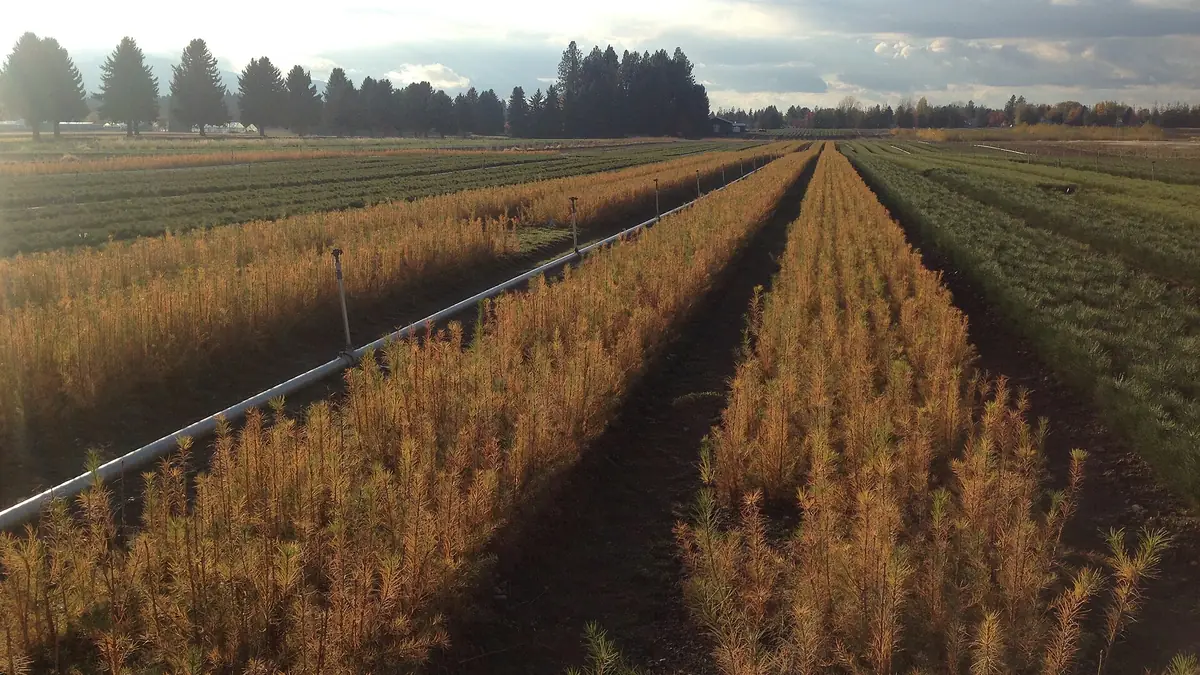
Vegetable crops share one trait that makes irrigation critical: shallow, fibrous root systems. A mature lettuce or spinach plant explores little more than the top 0.15-0.3 m of soil, and most of the water a carrot or onion uses comes from the top 0.3-0.6 m even though the taproot grows deeper. Compared with a full-canopy orchard that can draw on metres of profile, a vegetable crop has days of reserve, not weeks. When the topsoil dries, the crop responds in hours, and the response is usually visible in the marketable part.
Water demand follows the crop calendar. At peak summer demand, most vegetable crops use roughly 3-5 mm per day, or 25-40 mm per week, depending on crop, growth stage, and climate. Leafy greens at full canopy and celery in hot weather sit at the high end; root crops in the establishment phase sit lower. Because 1 mm over a hectare equals 10 m³ of water, a 4-hectare block at 30 mm per week needs about 1,200 m³ in that week, and the delivery system has to put it there at a rate the soil can absorb.
The failure modes are crop-specific, and they show up within days:
- Leafy greens: water stress accelerates flowering. Lettuce and spinach that run short during the pre-harvest weeks bolt, and bolted heads are unsaleable. Tipburn on lettuce and celery appears when the roots cannot supply the fast-growing inner leaves during hot, dry afternoons.
- Carrots and parsnips: alternating dry and wet soil produces cracking and forking. A carrot that stops growing in dry soil and then gets a heavy irrigation grows again, and the second growth splits the root. Heavy droplet impact on bare soil can also deflect young taproots.
- Onions and garlic: uneven moisture during bulb expansion causes doubling and splitting, and onions are slow to recover from a missed irrigation at bulbing.
- Potatoes: moisture swings at tuber set and bulking reduce grade. Stress followed by heavy irrigation can also produce growth cracks and second growth.
The scheduling implication is straightforward: vegetable ground wants steady, fairly frequent applications that keep the topsoil moist without waterlogging it. That fits sprinkler irrigation well, provided the application rate does not exceed what the soil takes in.
How Impact Sprinklers Fit a Vegetable Rotation
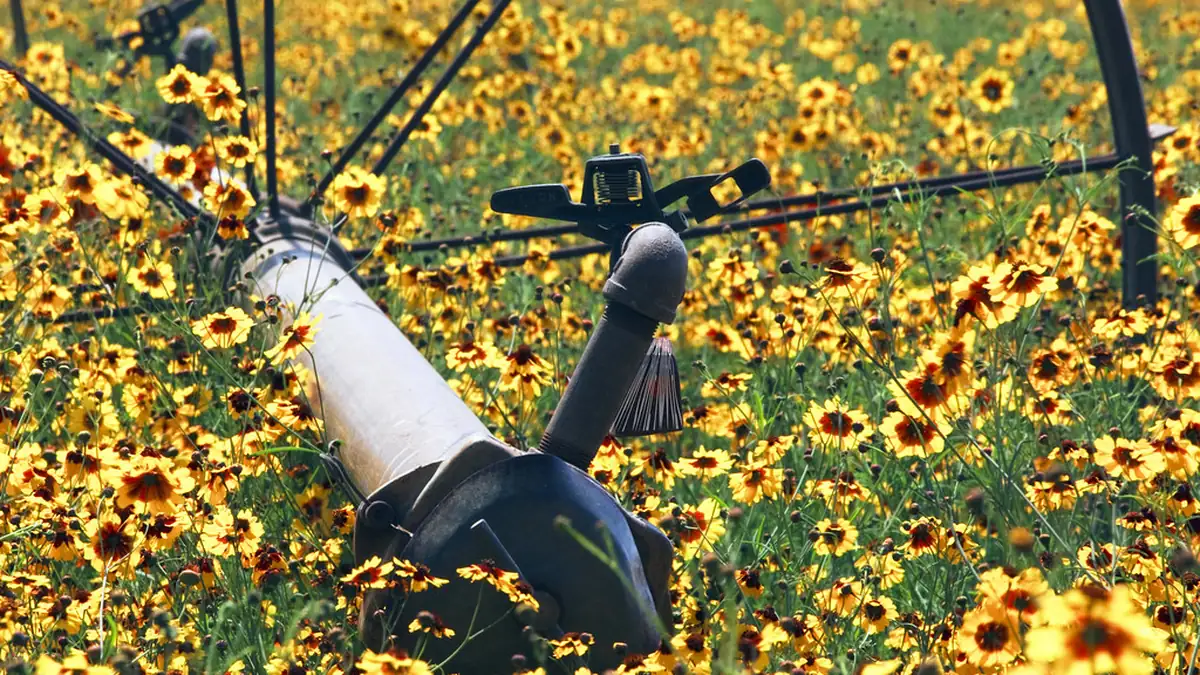
An impact sprinkler rotates through a spring-loaded drive arm that strikes the water stream and steps the head forward a few degrees with each blow. The mechanism is a body, one or two nozzles, a drive arm, and a diffuser pin, with no gears or bearings. On a vegetable farm, dusty fields, moving equipment, and rough water make that simplicity an advantage.
The operating numbers are what matter at field scale. Typical vegetable-field heads run at about 2.5-4.5 bar (35-65 psi) and throw 10-16 m, with flows of roughly 1-4 m³/h per head depending on nozzle size and pressure. A head at a 12 m radius covers about 450 m², so a 5-hectare block needs roughly 100-120 heads in a spaced grid, far fewer components than a drip system would require. A full rotation takes one to five minutes, and partial-circle models keep water off headlands, roads, and neighboring beds.
Two settings matter for vegetables specifically:
- Droplet size via the diffuser pin. Coarse droplets travel farther and hold up better in light wind; fine droplets are gentler on bare seedbeds and young seedlings. For carrot and onion establishment on crust-prone soil, a fine droplet setting reduces the surface crusting that blocks emergence.
- Rotation speed and arc, set so every bed is covered once rather than watered twice along edges and corners.
Timing is where vegetable growers earn their return from overhead irrigation. Wet foliage overnight invites disease in leafy greens, where downy mildew and botrytis spread through cool, damp canopies. Scheduling irrigations for early morning lets leaves dry through the day. In hot weather, a midday or late-afternoon cooling burst can drop canopy temperature by several degrees, which helps lettuce and celery through heat waves, at the cost of a little extra water to evaporation.
Riser height decides what the spray wets. On low-growing vegetable crops, heads are commonly mounted on risers of 0.5-1.2 m so the spray clears the canopy and falls across the whole bed. During germination, lower risers around 0.5-0.8 m keep fine droplets close to the seedbed, where they do the most good. Impact heads also tolerate pond and well water better than drip emitters because the nozzle orifices are large; a screen or strainer at the pump and periodic nozzle checks keep the season running.
Selecting Impact Sprinklers for Your Vegetable Farm
Three numbers come first: available flow from the water source, pressure at the block, and bed layout. Nozzle size is then matched to pressure and spacing rather than picked from a catalog. The ranges below are typical planning values, not a substitute for a hydraulic design.
| Crop group / field situation | Working pressure | Common inlet | Typical nozzle | Spacing | Riser height | Typical use |
|---|---|---|---|---|---|---|
| Germination and establishment (lettuce, carrot, onion seed) | 2.5-3.5 bar (35-50 psi) | 3/4” - 1” | 3-4 mm | 9-12 m | 0.5-0.8 m | Fine droplets, frequent light cycles to keep the seedbed moist |
| Leafy greens at full canopy (lettuce, spinach, celery) | 3-4 bar (45-60 psi) | 1” - 1 1/4” | 4-6 mm | 12-15 m | 0.5-1 m | 25-40 mm per week at peak, morning cycles, heat cooling |
| Root crops (carrots, onions, potatoes) | 3-4.5 bar (45-65 psi) | 1” - 1 1/4” | 5-7 mm | 12-15 m | 0.5-1 m | Steady moisture through bulking, less frequent than greens |
| Large blocks and multi-crop rotation (over 10 ha) | 4-5 bar (60-75 psi) | 1 1/2” - 2” | 6-9 mm | 15-18 m | 0.5-1.2 m | Fewer heads across big acreage, flexible across the rotation |
Layout and operating rules that decide whether the system works:
- Measure pressure at the riser, not at the pump. Friction losses in mains and laterals can change the picture by a bar or more on long runs.
- Plan for overlap. Lay heads out in a square or staggered grid with spacing close to the throw radius, because stress damage shows up first where coverage is thin.
- Match nozzle to pressure and spacing. An oversized nozzle at low pressure throws coarse, uneven patterns; an undersized nozzle at high pressure wastes energy and atomizes too finely.
- Check the application rate against the soil. On heavy clay, a high-rate head can exceed intake and run off before the water soaks in; on sand, the same head is fine. Fine droplets and shorter cycles reduce the risk on crust-prone ground.
- Size the flow before buying hardware. Heads per block multiplied by flow per head gives block demand, and it must sit inside the pump curve and the water source’s capacity.
- Order service kits with the heads. The drive-arm spring, seals, and washers wear first, while brass nozzles typically last many seasons.
Impact Sprinklers vs Drip in Vegetable Fields
Both systems grow excellent vegetables; they simply fit different constraints. Drip is the efficiency leader when water is scarce and rows stay fixed. Impact sprinklers cover whole blocks with fewer components, tolerate rougher water, and handle jobs drip cannot, such as full-bed germination, heat cooling, and frost protection. The table splits the work.
| Criterion | Impact sprinkler | Drip irrigation |
|---|---|---|
| Coverage per unit | Wide, 10-16 m radius | Point source at each emitter |
| Application rate per unit | High, about 1-4 m³/h per head | Low, about 1-4 L/h per emitter |
| Irrigation efficiency | Moderate, roughly 70-80% typical with evaporation and wind drift | High, water placed at the root zone |
| Wind sensitivity | Pattern shifts in wind; morning and evening cycles help | Minimal effect |
| Water quality tolerance | Good, larger orifices with a simple strainer | Lower, emitters need filtration |
| Germination over the full bed | Yes, uniform wetting across the bed | Needs seeding near the drip line or extra sprinklers |
| Foliage wetting | Wets leaves; morning scheduling limits disease risk | None |
| Heat and frost duty | Can cool the canopy and protect from frost | No practical effect on canopy temperature |
| Maintenance | Few moving parts, inexpensive service kits | Flushing, filtration, and emitter checks |
| Upfront hardware per hectare | Fewer heads, simpler filtration | More components per hectare |
Three realities worth weighing before choosing:
- If water is scarce, drip stretches every cubic metre furthest, and the case for it grows as water costs rise.
- If water is available but the farm runs a quick rotation across many crops, impact heads cover the whole rotation with one system and tolerate the pond or well water that often comes with farm-scale supplies.
- A hybrid is common: impact sprinklers for germination, heat events, and crops that rotate across wide beds, with drip on the high-value rows where water is the limiting input.
Frequently Asked Questions
Q: How much water do vegetable crops need per week? A: At peak summer demand, most vegetable crops use about 25-40 mm per week, or 3-5 mm per day, depending on crop, growth stage, and climate. Leafy greens at full canopy and celery in heat sit at the high end. Since 1 mm over a hectare equals 10 m³, a 4-hectare block at 30 mm per week needs about 1,200 m³ in that week.
Q: What pressure do impact sprinklers need on a vegetable farm? A: Typical vegetable-field heads run at about 2.5-4.5 bar (35-65 psi) and throw 10-16 m in that band. Measure pressure at the riser rather than at the pump, because friction losses in mains and laterals can cost a bar or more on long runs.
Q: Does overhead irrigation raise disease pressure in leafy greens? A: Wet foliage overnight is the main risk. Scheduling irrigations for early morning lets leaves dry through the day, which keeps downy mildew and botrytis pressure in check. A fine droplet setting and risers that clear the canopy also shorten the time leaves stay wet.
Q: Can impact sprinklers germinate lettuce, carrot, and onion seed? A: Yes, with fine droplets and frequent light cycles that keep the seedbed moist without crusting. A fine diffuser setting reduces droplet impact on bare soil, which matters for carrot and onion emergence on crust-prone ground.
Q: Impact sprinklers or drip for vegetable fields? A: It depends on the constraint. Drip is the stronger choice when water is scarce and rows stay fixed for the season. Impact sprinklers cover whole beds and rotating crops with fewer components, tolerate pond and well water better, and add heat cooling and frost protection. Many vegetable farms run both and assign each system where it earns its keep.
Q: How should I schedule irrigation for root crops? A: Root crops want steady moisture through bulking. Carrots, onions, and potatoes that alternate dry and wet produce cracks, splits, and misshapen roots. Light, regular cycles that keep the top 0.3-0.6 m of soil moist beat heavy, infrequent irrigations, and starting cycles in the morning leaves foliage dry by nightfall.
The Bottom Line
Vegetable crops carry little buffer: shallow roots, high value per hectare, and failure modes such as bolting, tipburn, cracking, and splitting that appear within days of a missed irrigation. Impact sprinklers answer with wide coverage, high flow per head, few moving parts, and tolerance for farm-scale water, and the same heads handle germination, heat cooling, and frost nights across a whole rotation. Sizing is where systems succeed or fail, so measure flow and pressure at the block first, then match nozzle, spacing, riser height, and droplet setting to the crop and soil.
IRRIGRAIN supplies impact sprinklers and agricultural irrigation fittings factory-direct, with OEM branding available for distributors and irrigation companies. Send your field size, water source flow, and pump pressure to cj226144@gmail.com and get a configuration matched to your numbers.
Frequently Asked Questions
How much water do vegetable crops need per week?
At peak summer demand, most vegetable crops use about 25-40 mm per week, or 3-5 mm per day, depending on crop, growth stage, and climate. Leafy greens at full canopy and celery in heat sit at the high end. Since 1 mm over a hectare equals 10 m³, a 4-hectare block at 30 mm per week needs about 1,200 m³ in that week.
What pressure do impact sprinklers need on a vegetable farm?
Typical vegetable-field heads run at about 2.5-4.5 bar (35-65 psi) and throw 10-16 m in that band. Measure pressure at the riser rather than at the pump, because friction losses in mains and laterals can cost a bar or more on long runs.
Does overhead irrigation raise disease pressure in leafy greens?
Wet foliage overnight is the main risk. Scheduling irrigations for early morning lets leaves dry through the day, which keeps downy mildew and botrytis pressure in check. A fine droplet setting and risers that clear the canopy also shorten the time leaves stay wet.
Can impact sprinklers germinate lettuce, carrot, and onion seed?
Yes, with fine droplets and frequent light cycles that keep the seedbed moist without crusting. A fine diffuser setting reduces droplet impact on bare soil, which matters for carrot and onion emergence on crust-prone ground.
Impact sprinklers or drip for vegetable fields?
It depends on the constraint. Drip is the stronger choice when water is scarce and rows stay fixed for the season. Impact sprinklers cover whole beds and rotating crops with fewer components, tolerate pond and well water better, and add heat cooling and frost protection. Many vegetable farms run both and assign each system where it earns its keep.
How should I schedule irrigation for root crops?
Root crops want steady moisture through bulking. Carrots, onions, and potatoes that alternate dry and wet produce cracks, splits, and misshapen roots. Light, regular cycles that keep the top 0.3-0.6 m of soil moist beat heavy, infrequent irrigations, and starting cycles in the morning leaves foliage dry by nightfall.