Orchard Irrigation with Impact Sprinklers: Protecting Fruit Trees Through Dry Seasons
2026-08-25
Orchard Irrigation with Impact Sprinklers: Protecting Fruit Trees Through Dry Seasons
A dry spell of five to eight weeks is not an inconvenience for an orchard; it is a yield event. Mature, full-canopy apple and stone fruit trees can draw 30-50 mm of water per week during peak summer demand, which works out to roughly 300-500 m³ per hectare per week. When the soil profile runs dry, the tree starts borrowing from the crop: fruit expansion slows, grade sizes drop, sunburn appears on exposed fruit, and a drought that carries into late summer can trim the flower buds that would carry next year’s crop. Impact sprinklers are one of the more robust answers to this problem, and they remain a practical choice for orchards where water is available and reliability matters more than marginal efficiency. This guide covers how impact sprinklers handle orchard duty, how to size them for a block, and where they sit next to drip irrigation.
Why Dry Seasons Hit Fruit Trees Hard
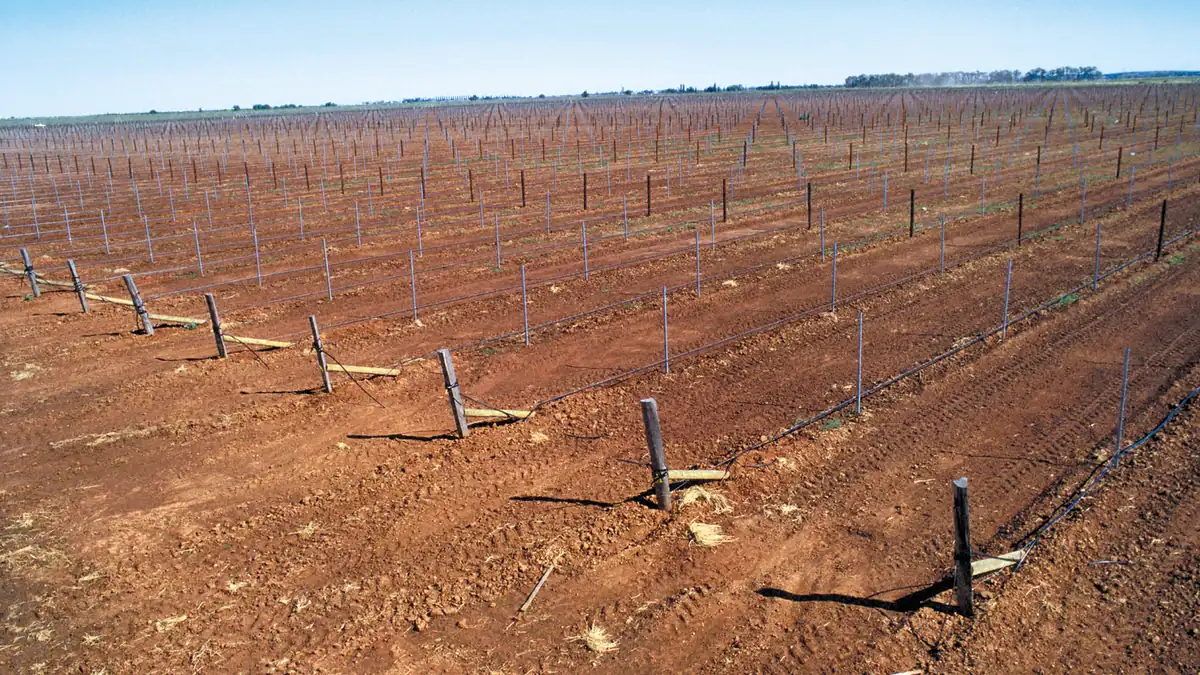
Fruit trees respond to water stress in stages, and the order matters. The first signs are subtle: shoot growth slows and leaves lose their midday turgor. If the soil profile keeps drying, the tree prioritizes survival over cropping. Stress during the cell-expansion phase of fruit growth typically shows up as smaller fruit at harvest, and fruit exposed to direct sun during hot, dry spells develops sunburn damage that lowers packout. A drought that extends into late summer can also reduce the number of flower buds set for the following season, which turns one dry year into two weak ones.
The arithmetic behind irrigation scheduling is simple and worth doing on paper. Mature, full-canopy orchards commonly use 3-6 mm of water per day at peak demand, or 25-40 mm per week depending on canopy size, climate, and crop load. Since 1 mm over a hectare equals 10 m³ of water, a 5-hectare block at 35 mm per week needs about 1,750 m³ in that week. If the source can only deliver a fraction of that, the practical question becomes how to apply limited water where it does the most good.
Root depth changes the answer. Most of the feeder roots that take up water and nutrients sit in the top 0.2-0.8 m of soil. Light, frequent applications that wet only the surface encourage shallow rooting and make the tree more fragile in the next dry spell. Deeper, less frequent applications that refill the profile encourage roots to follow the water down. Sandy soils hold less water per metre of depth and need more frequent cycles; clay and loam hold more and can go longer between irrigations.
Drought stress does not stop at the current crop. In addition to smaller fruit and sunburn, trees that finish a dry season short of water often show reduced return bloom the following spring, and young trees can suffer dieback that takes years to outgrow. That is why orchardists treat dry-season irrigation as an investment in two seasons at once.
How Impact Sprinklers Deliver Orchard Water
An impact sprinkler rotates through a spring-loaded drive arm that strikes the water stream and steps the head forward a few degrees with each blow. The whole mechanism is a body, one or two nozzles, a drive arm, and a diffuser pin, with no gears or bearings to pack up. In an orchard full of dust, spray residue, and long hot seasons, that simplicity is a feature.
The operating numbers are what make impact heads useful at orchard scale. Typical orchard-size heads run in a working pressure band of about 2.5-5 bar (35-75 psi) and throw a radius of roughly 12-18 m, with a flow of about 1-6 m³/h per head depending on nozzle size and pressure. A head covering a 15 m radius touches more than 700 m² of orchard floor, so a 10-hectare block can be covered by a few dozen heads rather than hundreds of emitters. A full rotation commonly takes one to five minutes, and many models set a partial circle so edges, headlands, and boundary rows are not watered twice.
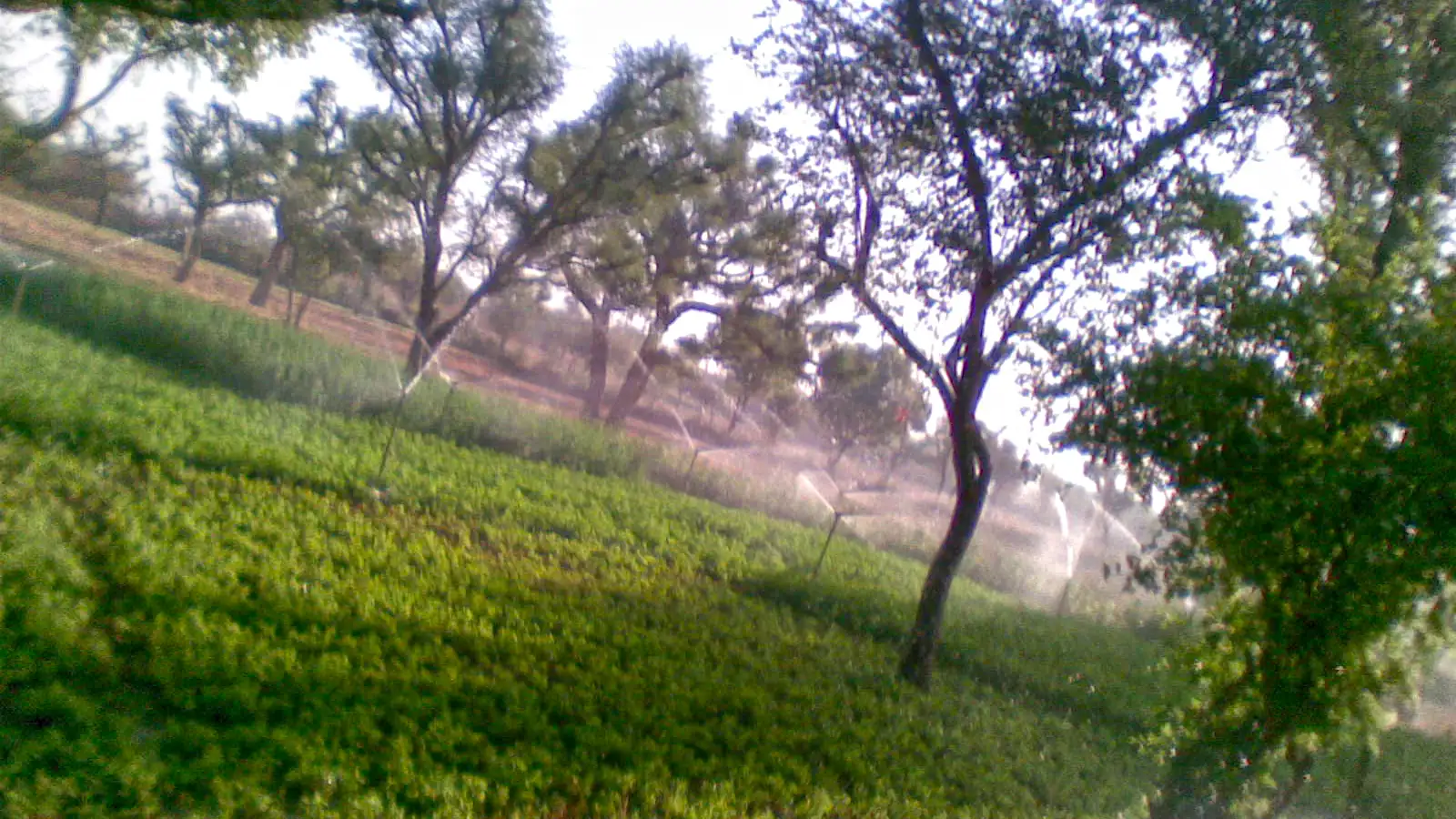
Two adjustments matter on the day the system runs. The diffuser pin breaks the stream into droplets: with the pin set for coarse droplets, water travels farther and holds up better in light wind; with fine droplets, coverage is gentler and better suited to cooling bursts during extreme heat. Rotation speed and arc are set to the block layout. Mounting height decides what the water wets. In orchards, heads on short risers of roughly 0.3-0.6 m water the under-canopy zone where the feeder roots live, while the foliage stays dry, which keeps disease pressure down. Overhead risers of 3-4 m are used when the job includes canopy cooling or frost protection.
Water quality is another reason impact heads keep appearing in orchards. The nozzle orifices are large relative to drip emitters, so heads tolerate pond and well water with suspended solids better than fine emitters do. That tolerance has limits: a simple screen or strainer at the pump and periodic nozzle checks still pay for themselves, especially after a well has been recently developed or a pond level has dropped.
Selecting Impact Sprinklers for Your Orchard
Three measurements come first: available flow from the water source, pressure at the block, and block geometry. Nozzle size is then matched to pressure and spacing rather than picked from a catalog. The ranges below are typical planning values, not a substitute for a hydraulic design.
| Orchard size | Working pressure | Common inlet | Typical nozzle | Spacing | Riser height | Typical use |
|---|---|---|---|---|---|---|
| Small blocks, young trees (under 2 ha) | 2.5-4 bar (35-60 psi) | 3/4” - 1” | 4-5 mm | 12-15 m | 0.3-0.6 m | Establishment and under-tree watering |
| Mid-size blocks (2-10 ha) | 3-4.5 bar (45-65 psi) | 1” - 1 1/4” | 5-7 mm | 15-18 m | 0.3-0.6 m | Whole-block dry-season irrigation |
| Large blocks (over 10 ha) | 4-5 bar (60-75 psi) | 1 1/2” - 2” | 7-9 mm | 15-18 m | 0.3-0.6 m | Fewer heads across big acreage, plus cooling |
Layout points that decide whether the system works:
- Measure pressure at the riser, not at the pump. Friction losses in mains and laterals can change the picture by a bar or more.
- Plan for overlap. Lay heads out in a square or staggered grid with spacing close to the throw radius so adjacent sprays overlap; drought damage shows up first where coverage is thin.
- Match nozzle to pressure. An oversized nozzle at low pressure throws coarse, uneven patterns; an undersized nozzle at high pressure wastes energy and atomizes too finely.
- Size the flow before the hardware. Multiply heads per block by flow per head to get the block demand, then check it against the source. A block demand that exceeds the pump curve will not be fixed by bigger nozzles.
- Order service kits with the heads. Drive-arm springs, seals, and washers age first; brass nozzles are long-lived but worth checking after seasons with sandy water.
Impact Sprinklers vs Drip Irrigation in Orchards
Many orchards run both. Drip does the day-to-day water economy, and impact sprinklers handle the jobs drip cannot. The table shows why the tools split the work.
| Criterion | Impact sprinkler | Drip irrigation |
|---|---|---|
| Coverage per unit | Wide, 12-18 m radius | Point source at each emitter |
| Application rate per unit | High, about 1-6 m³/h per head | Low, about 2-8 L/h per emitter |
| Irrigation efficiency | Moderate, 70-80% typical with evaporation and drift | High, water placed at the root zone |
| Wind sensitivity | Spray pattern shifts in wind | Minimal effect |
| Water quality tolerance | Good, larger orifices | Lower, emitters need filtration |
| Foliage wetting | Possible with overhead mounts; under-tree risers keep canopy dry | None |
| Frost and heat duty | Can cool the canopy and protect from frost | No practical effect on canopy temperature |
| Maintenance | Few moving parts, inexpensive service kits | Flushing, filtration, and emitter checks |
| Upfront hardware per hectare | Fewer heads, simpler filtration | More components, filters, and emitters per hectare |
| Typical role | Whole-block watering, establishment, cooling, frost | Precise, water-efficient irrigation where supply is limited |
Three realities are worth knowing before choosing:
- If water is scarce, drip stretches every cubic metre furthest. That is the standard argument for drip in arid districts with hard water limits.
- If water is available but labor and maintenance are the constraint, impact heads cover more ground per unit and tolerate rougher water, which keeps the season simpler.
- A hybrid is common: drip for routine feeding and irrigation through the season, with a solid-set impact system for establishment, heat events, and frost nights. The two systems do not compete; they cover different risks.
Frequently Asked Questions
Q: How much water does an orchard need through a dry season? A: At peak summer demand, mature full-canopy orchards commonly use 30-50 mm per week, which is 300-500 m³ per hectare per week. The real number depends on canopy size, climate, and crop load, so measure or estimate weekly demand before sizing the pump and water source.
Q: What pressure do impact sprinklers need in an orchard system? A: Typical orchard-size heads run at about 2.5-5 bar (35-75 psi) and throw 12-18 m in that band. Measure pressure at the riser, because friction losses in the mains can drop it well below pump pressure.
Q: Impact sprinklers or drip for a mature orchard? A: It depends on the water supply. Drip is the most efficient way to put water at the root zone and suits scarce supplies. Impact sprinklers cover far more area per head, tolerate particulates better, and can cool the canopy or protect from frost. Many orchards run drip for routine irrigation and impact heads for the jobs drip cannot do.
Q: Do impact sprinklers wet the foliage and raise disease risk? A: Overhead mounts do wet leaves. Mounting heads on short risers of 0.3-0.6 m keeps the canopy dry while watering the root zone, and scheduling irrigations for morning lets any incidental wetting dry quickly.
Q: What wears out on impact sprinklers? A: The drive-arm spring, seals, and washers age first. Service kits are inexpensive and quick to fit, and keeping kits on hand from day one is common practice. Nozzles, especially brass, typically last many seasons.
Q: Can I run impact sprinklers with pond or well water? A: Yes, the larger orifices handle suspended solids better than drip emitters, which is a common reason for choosing them on pond supplies. A simple screen or strainer at the pump and periodic nozzle checks keep the system reliable through the season.
The Bottom Line
A dry season is a two-season risk: it shrinks the current crop and can weaken the next one. Impact sprinklers answer with wide coverage, high flow per head, few moving parts, and tolerance for rougher water, and the same heads earn their keep for establishment and heat-stress cooling. Sizing is where systems succeed or fail, so measure flow and pressure at the block first, then match nozzle, spacing, and riser height to the layout.
IRRIGRAIN supplies impact sprinklers and agricultural irrigation fittings factory-direct, with OEM branding available for distributors and irrigation companies. Send your block size, water source flow, and pump pressure to cj226144@gmail.com and get a configuration matched to your numbers.
Frequently Asked Questions
How much water does an orchard need through a dry season?
At peak summer demand, mature full-canopy orchards commonly use 30-50 mm per week, which is 300-500 m³ per hectare per week. The real number depends on canopy size, climate, and crop load, so measure or estimate weekly demand before sizing the pump and water source.
What pressure do impact sprinklers need in an orchard system?
Typical orchard-size heads run at about 2.5-5 bar (35-75 psi) and throw 12-18 m in that band. Measure pressure at the riser, because friction losses in the mains can drop it well below pump pressure.
Impact sprinklers or drip for a mature orchard?
It depends on the water supply. Drip is the most efficient way to put water at the root zone and suits scarce supplies. Impact sprinklers cover far more area per head, tolerate particulates better, and can cool the canopy or protect from frost. Many orchards run drip for routine irrigation and impact heads for the jobs drip cannot do.
Do impact sprinklers wet the foliage and raise disease risk?
Overhead mounts do wet leaves. Mounting heads on short risers of 0.3-0.6 m keeps the canopy dry while watering the root zone, and scheduling irrigations for morning lets any incidental wetting dry quickly.
What wears out on impact sprinklers?
The drive-arm spring, seals, and washers age first. Service kits are inexpensive and quick to fit, and keeping kits on hand from day one is common practice. Nozzles, especially brass, typically last many seasons.
Can I run impact sprinklers with pond or well water?
Yes, the larger orifices handle suspended solids better than drip emitters, which is a common reason for choosing them on pond supplies. A simple screen or strainer at the pump and periodic nozzle checks keep the system reliable through the season.