Impact Sprinklers for Greenhouses: Climate Control and Even Watering for Nursery Crops
2026-08-23
Impact Sprinklers for Greenhouses: Climate Control and Even Watering for Nursery Crops
Inside a greenhouse, small watering mistakes compound fast. A flat of plugs that receives 20% less water than the bench beside it looks identical for a week — then it stalls, yellows unevenly, and quietly drops out of your sellable numbers. At the same time, summer ventilation cycles can push air temperature toward the crop’s stress threshold by mid-morning, and every degree above that line costs growth. Overhead impact sprinklers are one of the few tools that work on both problems at once: they throw a coarse, high-volume spray in a full circle — typically 12–18 m of throw at 2.5–5 bar — wetting a large bench area in minutes while briefly lifting humidity and pulling heat out of the air. Used well, they are a low-maintenance backbone for propagation houses, nursery ground beds, and open-bench greenhouses. Used badly — wrong spacing, wrong timing, wrong water — they turn a climate asset into a disease risk. This guide covers the four decisions that separate those two outcomes: coverage, climate timing, system choice, and layout.
Why Watering Uniformity Fails First in a Greenhouse
Greenhouse crops are grown tight. Plugs, seedlings, cuttings, and liner trays sit close together, so any variation in water delivery lands directly on the crop — there is no field spacing to buffer it. The failure points are predictable: benches near the door dry faster, edges beside vents shed water early, and undersized overhead pipe starves the far end of a run. Hand watering papers over some of this, but it consumes hours per day in peak season and its quality depends on whoever is holding the hose at 5 p.m.
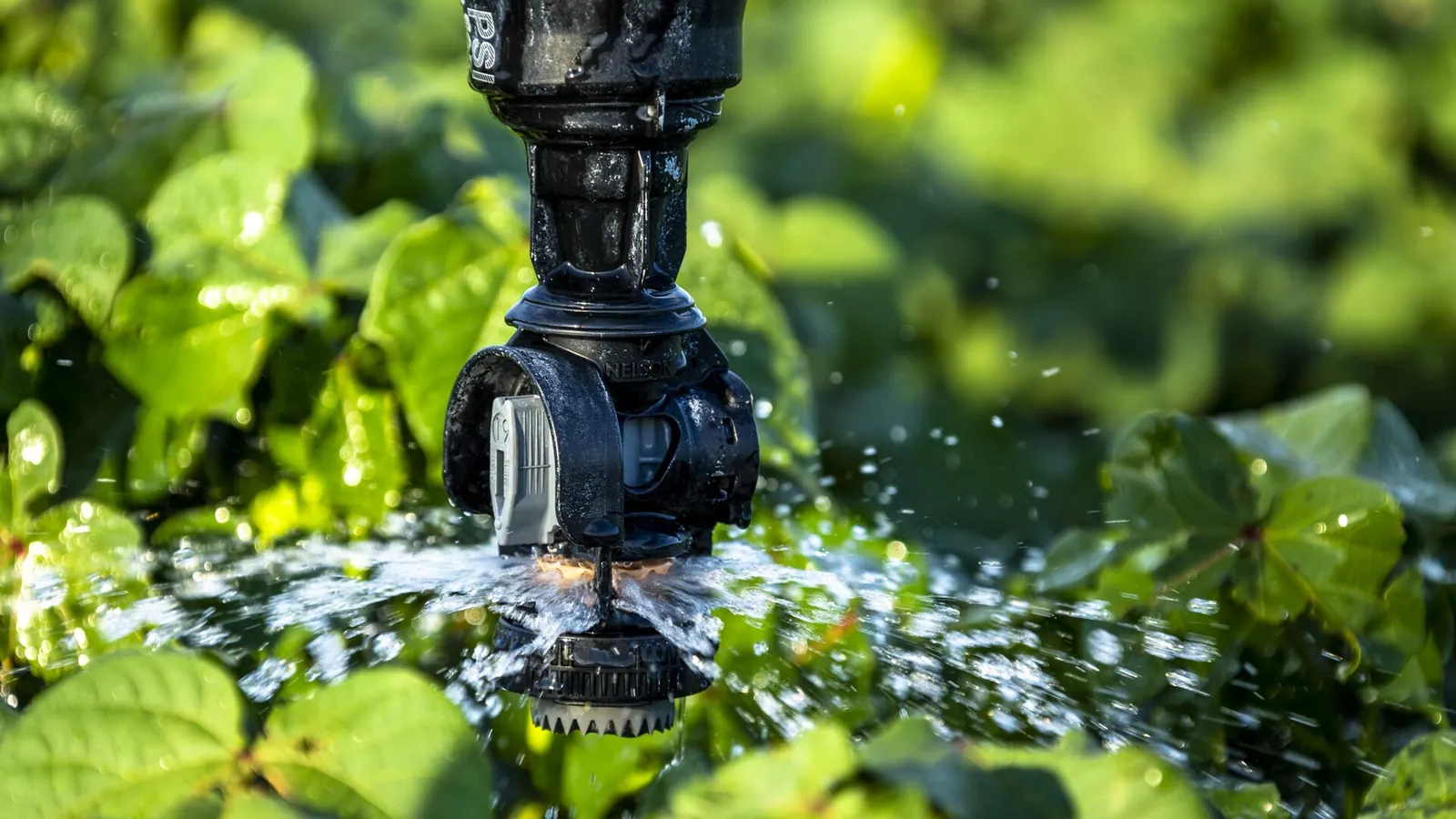
Impact sprinklers attack the cause rather than the symptom: overlapping circular coverage. When heads are spaced at roughly 60–80% of their wetting diameter, each sprinkler fills in its neighbor’s thin edges, and the uniformity coefficient (CU) of a well-laid-out overhead system commonly lands in the 75–85% range under real greenhouse conditions — adequate for most nursery crops when drainage is good. The payoff shows up where you can measure it: more even germination, more even rooting, and fewer saturated pockets where Pythium and damping-off find a foothold in seedling trays.
Uniformity alone justifies the change, but the labor math matters just as much for a commercial operation. One sprinkler head covers an area that would take several minutes of hand watering per cycle, and because the heads are mechanical — a weighted arm that trips on the water stream — they run unattended on a timer, cycle after cycle. That frees staff for potting, pinching, and shipping instead of hose duty.
Using Impact Sprinklers for Climate Control: Humidity, Cooling, and Recovery
Watering is only half of what overhead sprinklers do in a greenhouse; the other half is climate. When water evaporates from leaf surfaces and bench tops, it absorbs heat from the air, and a short overhead burst in a dry, ventilated house can shave several degrees off peak air temperature and lift relative humidity for a short window — exactly when transplants and fresh cuttings are losing water faster than their roots can replace it.
This matters most at three moments:
- Midday stress. When vent fans are running and humidity has dropped, a 3–5 minute burst of overhead spray reduces transpiration demand on young plants, preventing the wilt-and-recover cycle that slows growth.
- After transplanting and sticking cuttings. Newly potted liners and freshly stuck cuttings have compromised root systems. A gentle overhead wetting raises ambient humidity around the foliage while the roots re-establish, cutting moisture loss through the leaves.
- Heat-wave recovery. When air temperature approaches the crop’s stress threshold, overhead wetting buys time until conditions cool, keeping foliage turgid through the worst hours.
The discipline that keeps this a climate tool rather than a disease vector is timing. Foliage that stays wet into the evening gives botrytis and mildew an open door, so run overhead cycles in the morning on clear days, synchronize them with venting so the house dries off afterward, and skip evening cycles entirely unless conditions are unusual. Pairing the sprinklers with solenoid valves on a simple climate controller lets you set the sequence — water, vent, dry — and walk away.
Impact vs. Drip in a Greenhouse: A Working Comparison
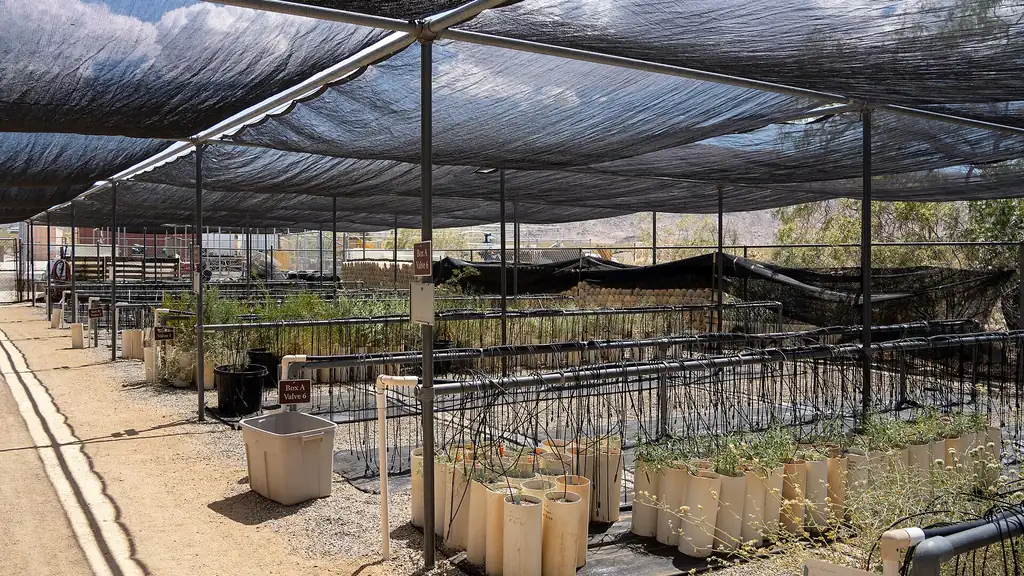
Drip irrigation is precise, and precision is seductive in a greenhouse — but precision has a cost, and it is not always the right tool for the job. The two systems solve different problems, and many commercial nurseries run both: drip on potted rows where per-plant dosing matters, overhead impact sprinklers on ground beds, propagation benches, and any area that needs climate support.
| Factor | Impact sprinklers (overhead) | Drip lines |
|---|---|---|
| Coverage pattern | Full circle or part circle, large wetting area per head | Targeted, per-plant or per-pot delivery |
| Typical area per emitter | One head covers a large bed (throw commonly 12–18 m at 2.5–5 bar) | One emitter waters a single pot or row section |
| Water use | Higher per cycle; some loss to evaporation and runoff on dense trays | Lower; water placed exactly where roots are |
| Foliage wetting | Wets foliage — useful for humidity and cooling, a risk if timed poorly | Keeps foliage dry — preferred for crops prone to foliar disease |
| Clogging sensitivity | Larger orifices, far less sensitive to sediment and recycled water | Small emitter paths require fine filtration and clean water |
| Failure points | Fewer emitters per area; a blocked head is easy to spot | Hundreds of emitters; one plugged line can dry a whole bench silently |
| Fertigation precision | Coarse, whole-area dosing | Precise, per-plant dosing |
| Climate effect | Raises humidity, provides evaporative cooling, supports recovery | None beyond root-zone moisture |
| Labor to install | Simple risers, stakes, or overhead rails | Laying, securing, and flushing thousands of meters of line |
| Typical fit | Propagation, ground beds, movable benches, dense flats, sediment-prone water | Potted rows, low-water situations, crops that must stay dry |
The rule of thumb: if the crop needs its leaves wet for climate reasons — or the water is dirty and the layout is dense — overhead impact sprinklers usually earn their place. If the crop must stay dry and every pot needs an exact dose, drip wins. When a greenhouse holds both types of crop, a hybrid layout with the two systems on separate valves is a straightforward answer.
How to Choose and Lay Out Impact Sprinklers for Your Greenhouse
Impact sprinklers are simple machines — a body, a nozzle, a weighted arm — but the choices between them change the result. The table below covers the selection decisions in the order they usually come up, with the common-sense ranges that apply across most greenhouse installations. If your setup sits outside these ranges, that is exactly when a sizing conversation beats a guess.
| Parameter | Typical range | Why it matters |
|---|---|---|
| Operating pressure | 2.5–5 bar (36–72 psi) | Below about 2 bar the arm rotation gets sluggish and coverage collapses into rings; above 5 bar you waste energy and create finer droplets that drift |
| Throw / wetting diameter | 12–18 m at working pressure | Sets your spacing; in a greenhouse you usually want the short end of the range so water stays off walls and glazing |
| Flow rate per head | Roughly 0.4–1.2 m³/h depending on nozzle and pressure | Adds up fast across a house — size your supply line and pump for the number of heads running at once, not per head |
| Spray pattern | Full circle, or part circle (commonly 90°/180°/270°) | Part-circle heads along walls and aisles stop wasted water and wet benches you did not mean to wet |
| Body material | Brass, zinc alloy, or engineering plastic | Brass lasts through years of handling and corrosion; plastic is lighter and cheaper for large installations; zinc sits between |
| Connection | 1/2” or 3/4” threaded, hose barb, or quick-couple | Match your riser and supply system; threaded brass is the most common greenhouse choice |
| Mounting | Stake, riser, or overhead rail | Riser height sets how high the spray clears tall crops; overhead rails suit movable benches |
Layout rules that prevent the classic mistakes:
- Space at 60–80% of wetting diameter, not at full throw. Overlap is what buys uniformity; stretching spacing to save heads creates dry rings that show up in the crop.
- Keep the spray off the structure. Aim part-circle heads inward from walls, and give glazing, roof trusses, and equipment a clearance margin — water on the frame accelerates corrosion and drips cold water onto crop below.
- Risers over tall crops. Bench height and crop stage change the effective throw; a sprinkler buried in a 1.5 m crop sprays uselessly. Raise the head so the stream clears the canopy.
- Regulate and filter. A pressure regulator at the zone valve keeps every head in its working band, and a simple screen filter is usually enough for impact sprinklers — nothing like the fine filtration drip demands. Still, filter anyway if you use recycled water.
- Plan for winter. In heated houses, drain or blow out overhead lines before frost; a frozen riser is a springtime repair you can schedule now instead.
We manufacture impact sprinklers factory-direct — the same production lines that supply brands you may already stock — which is why we can offer both standard greenhouse ranges and OEM batches: your own body finish, thread, part-circle angle, and packaging, with wholesale pricing. If you are choosing between brass and plastic, full circle and part circle, or simply want a second opinion on spacing, send us your layout and we will recommend a set rather than a catalogue.
FAQ
What water pressure do impact sprinklers need in a greenhouse? Most greenhouse impact sprinklers are designed to operate in the 2.5–5 bar range. Below roughly 2 bar, the arm stops rotating reliably and you get a wet ring instead of a covered circle; far above 5 bar, droplets get finer, drift increases, and you waste pump energy. If your supply pressure is outside this band, a zone pressure regulator is a simple fix. For an exact recommendation for your pump and pipe size, contact us with your setup.
Will overhead sprinkling cause disease in my crops? It can, if foliage stays wet into the evening or the house stays humid and still. The standard discipline is to run overhead cycles in the morning, synchronize with venting so the crop dries off during the day, and avoid evening watering. Crops with known foliar disease pressure are better served by drip or careful row watering.
Can I use impact sprinklers in a small hobby greenhouse? A full-size head throws 12–18 m, which is too much for a small house. Options include part-circle units aimed inward, shortened risers, and zoning the sprinkler to run only as a climate burst rather than as the main irrigation. If you share your house dimensions and water source, we can suggest a layout that fits.
Can impact sprinklers run automatically? Yes. A solenoid valve per zone plus a timer — or a climate controller that also reads temperature and humidity — will run your cycles, and a fertilizer injector can deliver foliar feed in the same pass. Most growers start with a simple timer and add climate logic later.
Do they clog with sediment or recycled water? Impact sprinklers use much larger orifices than drip emitters, so they tolerate sediment and recycled water far better. A basic screen filter is still good practice, and if your water carries heavy silt, a sand separator or settling tank protects the whole system. This tolerance is one of the main reasons overhead impact sprinklers remain popular in nurseries with open reservoirs.
Send Us Your Greenhouse and Get a Layout That Works
Uniformity problems and climate problems are easier to fix at the design stage than after the crop shows the damage. Tell us your greenhouse dimensions, bench and bed layout, water source and available pressure, and the crops you grow — we will reply with a recommended sprinkler set, spacing plan, and valve schedule, or a quote for a custom OEM batch with your own branding. Factory-direct means you deal with the people who make the sprinklers, not a distributor in between.
Contact us for a greenhouse sprinkler layout recommendation — send your layout and we will get a sizing proposal back to you within two working days.
Frequently Asked Questions
What water pressure do impact sprinklers need in a greenhouse?
Most greenhouse impact sprinklers are designed to operate in the 2.5–5 bar range. Below roughly 2 bar, the arm stops rotating reliably and you get a wet ring instead of a covered circle; far above 5 bar, droplets get finer, drift increases, and you waste pump energy. If your supply pressure is outside this band, a zone pressure regulator is a simple fix. For an exact recommendation for your pump a
Will overhead sprinkling cause disease in my crops?
It can, if foliage stays wet into the evening or the house stays humid and still. The standard discipline is to run overhead cycles in the morning, synchronize with venting so the crop dries off during the day, and avoid evening watering. Crops with known foliar disease pressure are better served by drip or careful row watering.
Can I use impact sprinklers in a small hobby greenhouse?
A full-size head throws 12–18 m, which is too much for a small house. Options include part-circle units aimed inward, shortened risers, and zoning the sprinkler to run only as a climate burst rather than as the main irrigation. If you share your house dimensions and water source, we can suggest a layout that fits.
Can impact sprinklers run automatically?
Yes. A solenoid valve per zone plus a timer — or a climate controller that also reads temperature and humidity — will run your cycles, and a fertilizer injector can deliver foliar feed in the same pass. Most growers start with a simple timer and add climate logic later.
Do they clog with sediment or recycled water?
Impact sprinklers use much larger orifices than drip emitters, so they tolerate sediment and recycled water far better. A basic screen filter is still good practice, and if your water carries heavy silt, a sand separator or settling tank protects the whole system. This tolerance is one of the main reasons overhead impact sprinklers remain popular in nurseries with open reservoirs.