Dust Control with Sprinklers: Construction & Mining Site Solutions
2026-08-25
Dust Control with Sprinklers: Construction & Mining Site Solutions
The worst dust day on a surface mine usually starts the same way: a 40-tonne haul truck rolls past a dry section of road, a plume hangs over the crusher apron, and the PM10 monitor at the fence line drifts toward the 150 µg/m³ daily limit that the US EPA enforces as the 24-hour standard. One exceedance notice, one visibility incident between two trucks, or one complaint letter from a neighbour is enough to stall a shift, trigger a corrective-action plan, and burn budget on consultants and paperwork that a watering system could have prevented.
Sprinkler-based dust control is the workhorse answer, and it is not the weak option that “just watering the ground” sounds like. Large impact sprinklers push serious volumes of coarse, wind-resistant droplets over wide fixed areas, day and night, without a driver, a diesel bill, or a pump truck idling in a blast zone. This guide covers how dust becomes a compliance problem, how high-flow impact sprinklers suppress it, how to select heads zone by zone, and how sprinkler systems compare with cannons, misting and water trucks on the metrics that actually matter.
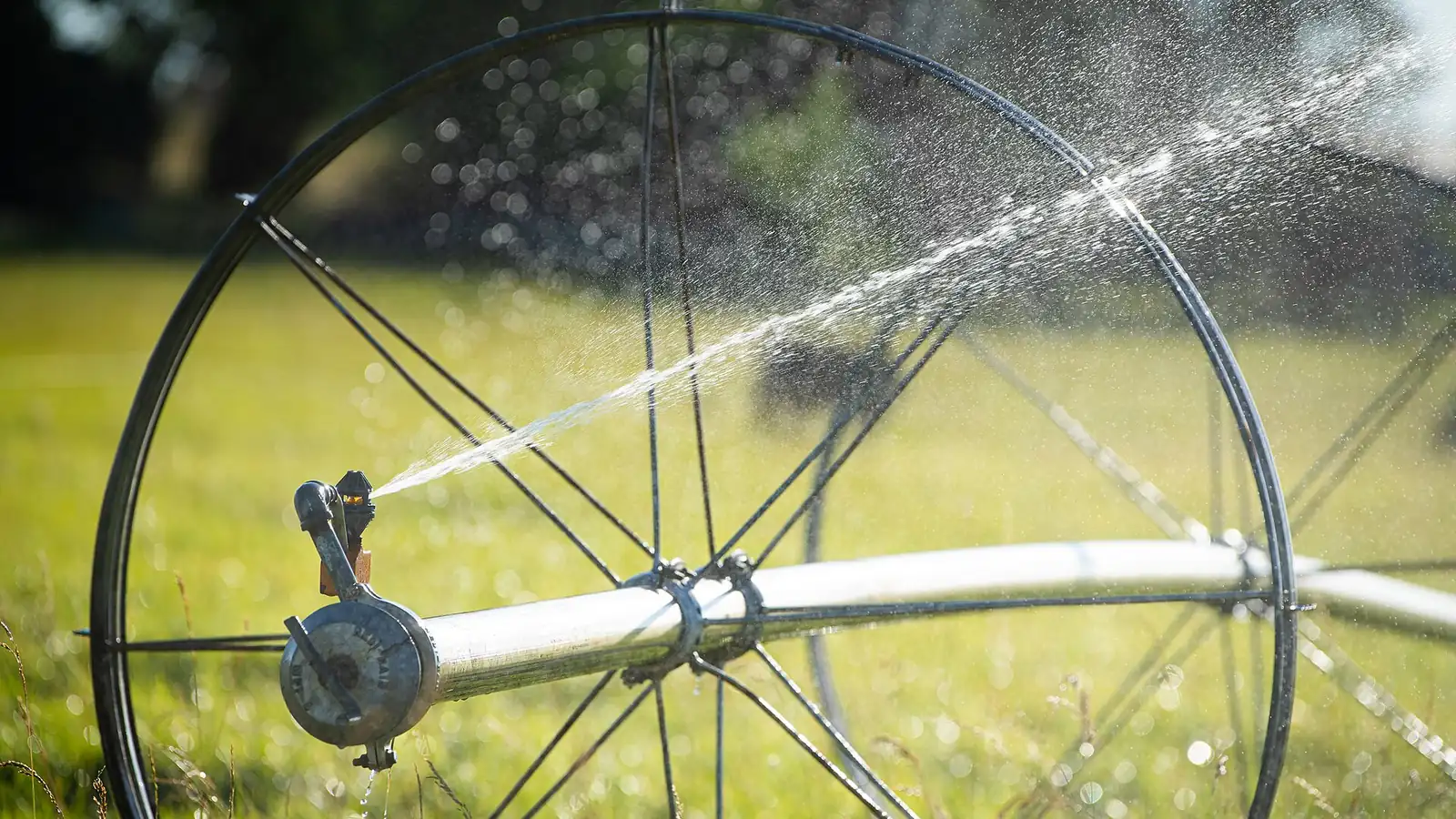
Key Takeaways
- Haul roads are typically the single largest fugitive dust source on surface mine sites, often accounting for 50% or more of total dust emissions, and they are also the easiest zone to control with fixed sprinklers.
- Large impact sprinklers throw 25-40 m at flows of roughly 20-40 m³/h per head in the 4-5 bar sweet spot, with coarse 1-3 mm droplets that resist wind drift.
- A wetting pass applies 1-2 L/m²; cycle timing (every 1-4 hours on active roads) matters more than raw flow for both compliance and water cost.
- Open-body impact design handles recycled pond water and grit that would jam gear-driven rotors or block mist nozzles, which makes it a natural fit for mine water supplies.
- Factory-direct sourcing cuts per-head cost and unlocks OEM options such as custom nozzling, colour-coded bodies and private labelling for contractors and distributors.
Why Fugitive Dust Becomes a Compliance and Cost Problem
Dust is not a nuisance issue on an active site; it is a measured, regulated emission. Ambient air rules such as the US EPA PM10 standard (150 µg/m³ over 24 hours) and the EU Ambient Air Quality Directive (50 µg/m³ daily limit for PM10) give regulators a number to enforce, and workplace exposure limits such as the OSHA respirable dust PEL of 5 mg/m³ put the same pressure on the people inside the fence. When a site cannot show an effective suppression program, the consequences arrive as monitoring exceedances, corrective-action plans, and stop-work orders at the worst possible time.
The sources are predictable. Haul roads generate dust every time a loaded truck passes, because the tyres grind the surface and the wake lifts fine particles into the air; on many surface operations this single source dominates the emission inventory. Stockpiles shed dust from wind erosion on their upper faces, crushers and transfer points release dust at the point of impact, blast areas throw a short-lived but intense plume, and active excavation faces dry out within hours of watering.
The operational costs stack up alongside the regulatory ones. Dust reduces visibility on haul roads, which is a direct safety risk for operators running 40-tonne machines at 40 km/h. Airborne fines clog engine intake filters, hydraulic seals and cab filtration, shortening service intervals on expensive equipment. Sites near residential areas add a third cost: complaints that force watering schedules, monitoring reports and, in the worst cases, legal pressure to cut production.
Sprinkler-based suppression attacks the problem at the surface, which is where most of the dust starts. Water binds the fine particles to the road or stockpile surface, keeps the material too heavy to be lifted by traffic and wind, and does it across the whole footprint of the site rather than only on the strips a truck can reach. That is why fixed sprinklers, not mobile spraying, remain the backbone of dust programs on large construction and mining sites.
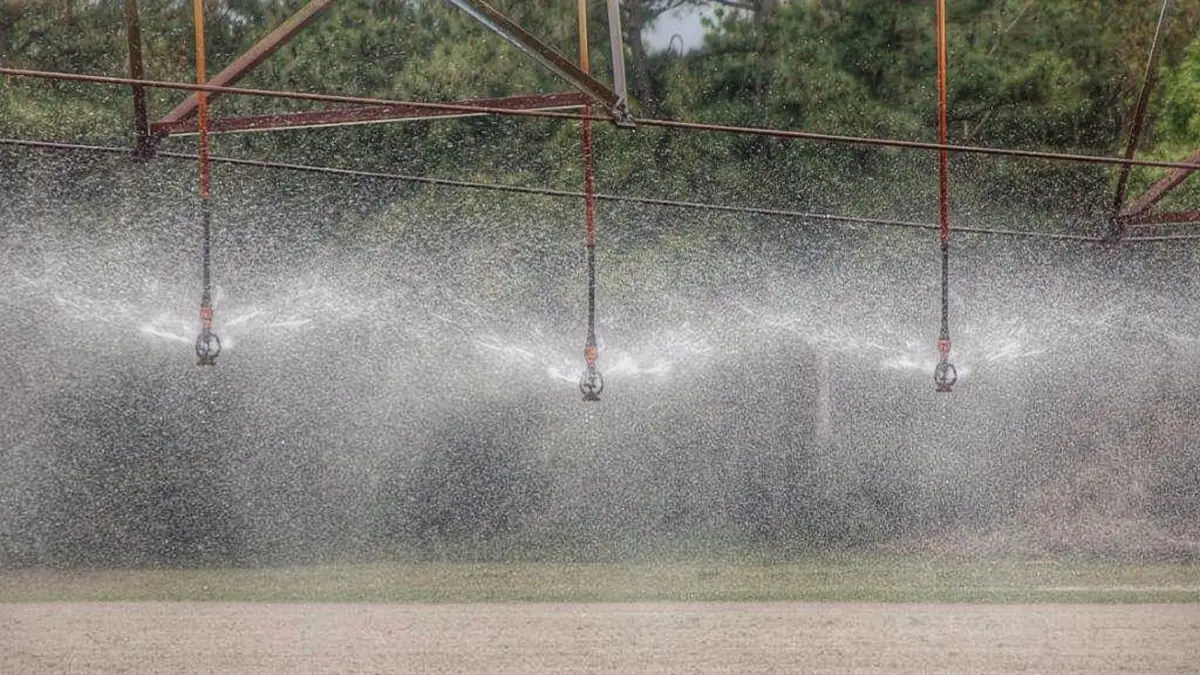
How High-Flow Impact Sprinklers Actually Suppress Dust
Suppression works through two distinct mechanisms, and they need different tools. Surface wetting binds dust at the source: water penetrates the top layer of the road or stockpile, capillary forces hold the fines down, and re-suspension drops sharply until the surface dries again. Airborne capture works differently: fine water droplets collide with suspended particles and drag them to the ground. Impact sprinklers are built for the first mechanism, which is exactly where the bulk of haul-road and stockpile dust lives.
The physics of the droplet matters more than the volume. An impact sprinkler produces a pulsed, coarse stream of roughly 1-3 mm droplets. Large droplets carry more momentum, penetrate the surface instead of evaporating mid-air, and fall close to the head, so a 30-40 km/h wind shifts coverage by only a small fraction of the radius. Fine mist, by contrast, is efficient at capturing airborne dust but drifts with the wind, evaporates in dry heat before reaching the ground, and needs high pressure and clean water to run at all.
Large impact sprinklers are genuinely high-flow devices. A typical 2-inch (DN50) impact model throws 25-40 m and moves 20-40 m³/h at 4-6 bar, which means one head can wet a strip of haul road hundreds of square metres in area per cycle. Full-circle and part-circle settings let the same head water a stockpile dome or stay aimed inside the road corridor instead of soaking the berm. The precipitation rate is high enough that a 15-30 minute cycle leaves a visible wet surface, which is the state that actually suppresses dust.
The design also survives the site. An impact head has one main moving part, the spring-loaded drive arm, and large open nozzle passages. That combination tolerates the grit, silt and recycled pond water that a mine site is likely to feed it, where a gear-driven rotor would bind on particulates and a misting nozzle would clog. Maintenance is a worn arm spring or a blocked nozzle, both of which are minutes of work with common tools and cheap spare parts.
The honest limitation: sprinklers wet surfaces, they do not scrub an airborne plume above head height. A crusher discharge tower or conveyor transfer point that lifts dust above the reach of a surface stream needs a mist cannon or local extraction. On most sites the practical split is sprinklers for the 90% of area that generates dust from the ground, and cannons at the handful of points where dust escapes into the air.
Sprinkler Selection by Site Zone
Not every zone needs the same head. The selection table below maps typical dust zones to a sensible sprinkler class, with flow and radius ranges that are common for impact models in each size bracket. Treat the numbers as planning ranges, not model specifications, and confirm final sizing against your water supply and site survey.
| Application zone | Recommended setup | Typical flow per head | Wetted radius | Notes |
|---|---|---|---|---|
| Haul road (main) | 1.5-2” impact, part-circle, riser mounted 1-2 m above grade | 15-40 m³/h | 25-40 m | Space at 60-70% of wetted diameter; aim heads inward to avoid wetting the berm |
| Haul road (secondary / access track) | 1-1.5” impact, part-circle | 6-20 m³/h | 15-30 m | Lower cycle frequency; timer zones can share a pump |
| Stockpiles and material bays | 2” full-circle impact on top of the pile or elevated posts around the base | 20-40 m³/h | 25-40 m | Wind erosion hits the upper faces; cover the crest first |
| Blast and excavation areas | Portable 1.5-2” impacts on quick-couple stands | 10-40 m³/h | 20-40 m | Move with the working face; pre-wet 30-60 minutes before blasting |
| Crusher apron and transfer zones | 2” impact at perimeter + mist cannon at the discharge point | 20-40 m³/h | 25-40 m | Sprinkler binds spillage on the apron; cannon handles the airborne plume |
| Tailings beaches and pond edges | 2” full-circle impacts, corrosion-resistant bodies | 20-40 m³/h | 25-40 m | Expect the worst water quality on site; oversized nozzles and coarse filtration help |
Three sizing rules apply across every zone. First, spacing: irrigation-standard head-to-head coverage works out to about 50-60% of wetted diameter, and dust duty can push to 60-70% because uniformity matters less than keeping the surface wet — wider spacing means fewer heads and lower cost. Second, pressure: design for 4-5 bar at the head, not at the pump, and calculate friction loss across the longest pipe run before choosing pipe size. Third, water: budget a wetting pass of 1-2 L/m², multiply by your watered area and the number of cycles per day, and size the pump and storage tank from that number, not from gut feel.
Impact Sprinklers vs. Water Cannons, Mist Systems and Water Trucks
Fixed sprinklers are one option among several, and the right answer depends on the zone, the water supply and the budget. The comparison table below lays out the trade-offs on the metrics that site managers actually compare.
| Factor | Fixed impact sprinklers | Water cannon (mobile) | Mist cannon / fog system | Water truck |
|---|---|---|---|---|
| Typical reach | 25-40 m per head, fixed pattern | 30-80 m jet, manually aimed | 50-150 m with 50-150 micron droplets | Coverage of driven route only |
| Suppression mechanism | Surface wetting, binds dust at source | Surface wetting + some airborne knockdown | Airborne capture of suspended dust | Surface wetting along the route |
| Wind sensitivity | Low (coarse droplets fall close to head) | Moderate | High (fine mist drifts and evaporates) | Low, but dust rises again within hours |
| Labour per shift | Near zero after install | Operator required | Operator or fixed unit | Driver + refill cycles every 1-4 hours |
| Capital cost per m² | Low to moderate | Moderate (machine cost) | High (pumps, nozzles, filtration) | High (fleet + fuel + maintenance) |
| Water quality tolerance | High (open body, large nozzles) | Moderate | Low (clean water required) | Moderate |
| Strongest fit | Haul roads, stockpiles, large open areas | Small sites, spot duty, irregular layouts | Crushers, transfer towers, fence-line plumes | Short roads, emergency response, compaction support |
The pattern is consistent: impact sprinklers win on cost per square metre, labour, and tolerance for dirty water, and lose only where dust is already airborne. Water trucks look flexible but are the most expensive way to keep a fixed area wet over a full season — a 20,000 L tanker covering 10,000 m² at 1.5 L/m² makes fewer than two passes per load, and the driver’s time, fuel and maintenance bill for every day of the year adds up fast. Cannons and mist systems earn their price only at the specific points where surface wetting cannot reach, so most well-run programs combine them: sprinkler zones as the base layer, cannons at the two or three hot spots where the compliance monitor sits.
Frequently Asked Questions
Q: How much water does a sprinkler-based dust control system use?
A: A typical wetting pass applies 1-2 L/m², and cycles repeat every 1-4 hours depending on traffic, wind and temperature. A haul road of 10,000 m² wetted twice a day at 1.5 L/m² consumes about 30,000 L/day. Metering flow and cycling zones instead of running everything continuously is the fastest way to control the water bill.
Q: What pressure do dust-control impact sprinklers need?
A: Most large impact models rated for dust duty work in the 3-6 bar range, with 4-5 bar at the head giving full-rated throw. Measure pressure at the farthest heads in the run rather than at the pump, because friction loss in long pipes can drop pressure below the nozzle’s useful range.
Q: Can sprinklers run on recycled mine water or pond water?
A: Yes, and this is one of their advantages. The open-body impact design and large nozzle passages tolerate grit and suspended solids far better than gear-driven rotors or misting nozzles. Fit a strainer or disc filter sized to the nozzle opening upstream, and flush lines on a schedule when the supply is pond or recycled water.
Q: How many sprinklers do I need to cover a haul road?
A: Work from the wetted radius and the spacing rule. For dust duty, heads are typically spaced at 60-70% of wetted diameter along the road, with part-circle heads aimed inward from the edge. A road 2 km long with 35 m radius heads spaced at 45 m intervals needs roughly 45 heads per side, before you adjust for terrain and power supply.
Q: Are sprinklers enough for dust compliance, or do I need a mist cannon too?
A: They solve different problems. Sprinklers wet surfaces and bind dust at the source, which handles haul roads, stockpiles and excavation areas. Mist cannons suppress airborne plumes that escape above head height, such as crusher discharge or conveyor transfer points. Many sites run sprinklers as the base layer and add cannons at the few high-emission points where a compliance monitor actually sits.
Q: Do dust-control sprinklers still work in windy conditions?
A: Better than fine mist systems. The coarse droplets from an impact head (roughly 1-3 mm) fall out close to the head, so a 30-40 km/h wind shifts coverage far less than it does with 50-150 micron mist. Expect some drift and uneven edges in strong gusts, and adjust watering cycles toward calmer morning and evening windows where practical.
Your Next Step
A dry haul road is the cheapest dust problem to prevent and the most expensive one to defend in front of a regulator. Fixed impact sprinklers give you full-footprint coverage at a fraction of the running cost of a water truck, with the simple, grit-tolerant construction that site water demands.
Send us your site layout, water supply details and target radius for a factory-direct quote: email cj226144@gmail.com or use our contact form today, and ask about OEM options such as custom nozzling, corrosion-resistant bodies and private labelling for your contractor brand or distribution network.
Related reading: Impact sprinkler product range · Contact IRRIGRAIN
Frequently Asked Questions
How much water does a sprinkler-based dust control system use?
A typical wetting pass applies 1-2 L/m², and cycles repeat every 1-4 hours depending on traffic, wind and temperature. A haul road of 10,000 m² wetted twice a day at 1.5 L/m² consumes about 30,000 L/day. Metering flow and cycling zones instead of running everything continuously is the fastest way to control the water bill.
What pressure do dust-control impact sprinklers need?
Most large impact models rated for dust duty work in the 3-6 bar range, with 4-5 bar at the head giving full-rated throw. Measure pressure at the farthest heads in the run rather than at the pump, because friction loss in long pipes can drop pressure below the nozzle's useful range.
Can sprinklers run on recycled mine water or pond water?
Yes, and this is one of their advantages. The open-body impact design and large nozzle passages tolerate grit and suspended solids far better than gear-driven rotors or misting nozzles. Fit a strainer or disc filter sized to the nozzle opening upstream, and flush lines on a schedule when the supply is pond or recycled water.
How many sprinklers do I need to cover a haul road?
Work from the wetted radius and the spacing rule. For dust duty, heads are typically spaced at 60-70% of wetted diameter along the road, with part-circle heads aimed inward from the edge. A road 2 km long with 35 m radius heads spaced at 45 m intervals needs roughly 45 heads per side, before you adjust for terrain and power supply.
Are sprinklers enough for dust compliance, or do I need a mist cannon too?
They solve different problems. Sprinklers wet surfaces and bind dust at the source, which handles haul roads, stockpiles and excavation areas. Mist cannons suppress airborne plumes that escape above head height, such as crusher discharge or conveyor transfer points. Many sites run sprinklers as the base layer and add cannons at the few high-emission points where a compliance monitor actually sits.
Do dust-control sprinklers still work in windy conditions?
Better than fine mist systems. The coarse droplets from an impact head (roughly 1-3 mm) fall out close to the head, so a 30-40 km/h wind shifts coverage far less than it does with 50-150 micron mist. Expect some drift and uneven edges in strong gusts, and adjust watering cycles toward calmer morning and evening windows where practical.