Golf Course Irrigation: Why Impact Sprinklers Still Win on Fairways and Roughs
2026-08-23
Golf Course Irrigation: Why Impact Sprinklers Still Win on Fairways and Roughs
A typical 18-hole course moves millions of litres of water a week in peak season, and most of it lands on fairways and roughs. Those are also the zones where irrigation budgets get squeezed hardest. Picture the worst-case Tuesday: one rotor bank dies mid-season, the gear drive needs a full day of labour to rebuild, and the fairway shows dry stress lines before the weekend. Repeat that failure pattern across 18 holes and the maintenance crew is fighting turf loss all summer instead of managing it.
Impact sprinklers never went away. The classic arm-and-spring design still carries a large share of fairway and rough irrigation on courses of every age, because it is cheap per head, simple to repair, and tough enough for dirty water and long shifts. This guide covers where impacts fit on a golf course, how they compare with gear-driven rotors, and how to spec them without overspending.
Key Takeaways
- Typical golf-grade impact models throw 12–18 m and work in a roughly 2.5–5 bar pressure window, with a 3.5–4.5 bar sweet spot for full-radius fairway duty.
- The drive arm is the only main moving part, which means fewer failure points than a gear-driven rotor.
- Coarse droplets resist wind drift, and the open mechanism handles reclaimed water and fertigation better than many rotors.
- Per-head cost sits at a fraction of a comparable rotor, which matters when you are irrigating dozens of hectares.
- Factory-direct sourcing trims that cost further and unlocks OEM options: custom nozzling, colours, and private labelling.
Where Impact Sprinklers Still Earn Their Keep
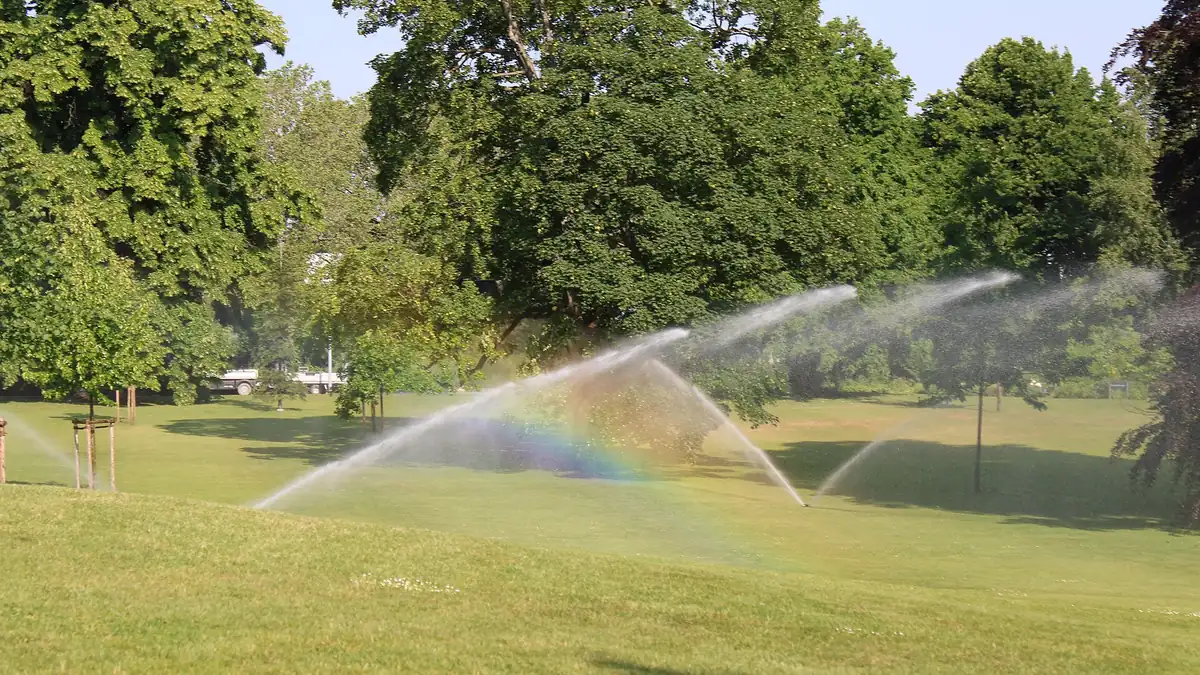
Greens are not the place for impact sprinklers. Fine turf wants small droplets, high uniformity, and quiet operation, which is why rotors and spray heads dominate putting surfaces and most tees. Fairways and roughs are a different assignment: they want volume, toughness, and the lowest possible cost per irrigated hectare. That is the impact sprinkler’s home ground.
Fairways
Fairways are wide, open corridors that often need 25–40 mm of water per week in summer heat. The irrigation demand is high, but the aesthetic standard is a step below greens, so the priority is coverage and reliability, not droplet finesse. A pop-up impact head with a 15–18 m throw covers a wide band from a single point, and its higher precipitation rate means shorter run times per cycle. On a long night shift, shorter cycles matter: the crew finishes earlier and the pump station works less.
Roughs
Rough is the biggest irrigated area on most courses and usually the last to get budget. The turf standard is “playable and alive,” so heads get spaced wide and the water quality is often the worst on site: pond water, reclaimed supply, or fertigation lines running through the same system. Impacts tolerate that environment. Their internal passages are open, the stream is coarse, and the drive mechanism is one spring-loaded arm that keeps working when a gear train would bind on grit.
Semi-rough, ranges, and out-of-play areas
The same logic extends outward. Semi-rough and driving-range turf run on part-circle impacts with modest throws, and out-of-play or native areas can get away with the cheapest reliable heads on the system. Many courses run a hybrid fleet on purpose: rotors on greens and tees, impacts from fairway edge to boundary fence.
Impact vs Rotary: What Actually Changes in the Field
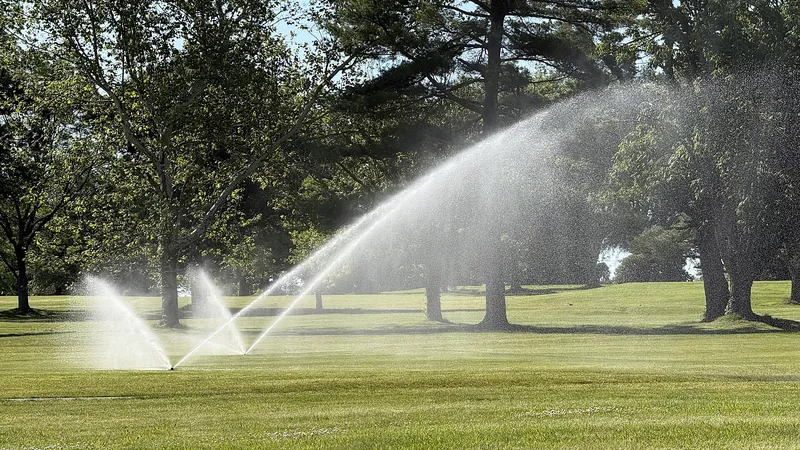
The difference is mechanical, not cosmetic. An impact sprinkler drives itself with a spring-loaded arm that strikes the stream and ratchets the head around. A gear-driven rotor uses an internal train of gears to rotate the nozzle slowly. That one design choice drives everything below.
| Factor | Impact sprinkler | Gear-driven rotor |
|---|---|---|
| Drive mechanism | Spring-loaded arm striking the water stream | Internal gear train (usually planetary) |
| Main moving parts | One (the arm) | Gear train, seals, multiple small components |
| Typical working pressure | ~2.5–5 bar | Often ~3–5 bar, with a narrower sweet spot |
| Throw radius (golf models) | ~12–18 m | ~15–25 m at comparable flow |
| Precipitation rate | Higher at typical spacings (roughly 10–20 mm/hr) | Lower, adjustable over a wider range |
| Droplet size | Coarse, large droplets | Fine droplets |
| Wind behaviour | Large droplets drift less in gusts | Finer droplets are more prone to drift |
| Distribution uniformity | Good when spaced head-to-head | Generally higher DU at proper spacing |
| Water quality tolerance | Handles particulates and reclaimed water well | More vulnerable to clogging and gear jams |
| Field maintenance | Arm and spring swaps, nozzle cleaning | Gear service, seals, nozzle care |
| Head cost | Low | Higher |
| Noise | Audible clicking | Quiet |
| Typical golf use | Fairways, roughs, ranges, native areas | Greens, tees, fairways, sports turf |
Three differences deserve extra attention before you buy.
Water quality. If your course irrigates with reclaimed water, pond water, or a fertigation program, the sprinkler mechanism sits inside the dirtiest part of the system. Rotors pull water through small nozzles and a sealed gear train; debris that slips past the filter has nowhere to go. An impact’s stream passes straight through an open body, and the arm does its work on the outside of the head. It is not a filter substitute, but it is less prone to jamming on the particulates that kill rotors.
Wind. Coarse droplets from an impact head fall fast and stay close to the target zone. On an exposed fairway in a 20 km/h breeze, that is a visible difference in where the water actually lands. The trade-off is surface crusting risk on fine turf, which is exactly why impacts belong on fairways and roughs rather than greens.
Cost to maintain. A mid-size rotor costs several times more than an impact head of similar throw, and its repair kit is more expensive. The impact repair is an arm, a spring, and a wrench. Many superintendents keep a small stock of arms and springs in the shop and fix heads on the spot, in minutes, without pulling the rotor out of the ground.
How to Select an Impact Sprinkler for Fairway and Rough Duty
Spec from the zone backwards. Decide the radius and pressure first, then the body and nozzle options, then the commercial terms.
| Zone | Typical radius needed | Working pressure | Priority specifications |
|---|---|---|---|
| Fairway | 15–18 m | 3.5–4.5 bar | Full- and part-circle versions, coarse stream, brass or stainless drive arm, tool-free arc adjustment |
| Rough | 12–15 m | 2.5–3.5 bar | High-flow nozzles, taller pop-up to clear the canopy, sturdy body for mower impacts |
| Semi-rough / fringe | 10–12 m | 2.5–3.5 bar | Part-circle heads, lower throw to protect adjacent fine turf |
| Driving range | 15–18 m | 3.5–4.5 bar | Impact-resistant body, optional guard cage, easy nozzle access |
| Out-of-play / native | 12–18 m | 2.5–4 bar | Lowest cost per head, minimal service requirement |
Beyond the table, check four things on every candidate head.
Arc adjustment. Fairway edges and rough boundaries need part-circle operation without climbing into the valve box. Look for heads with a tool-free arc adjustment across the 20° to 360° range, and confirm the adjustment mechanism survives field abuse.
Body material. Brass and stainless heads cost more and last decades; all-plastic heads are cheaper and fine where replacement labour is cheap. For mower-hit zones like rough, many courses prefer a heavy body that shrugs off contact over a cheap one that snaps.
Pop-up height. Tall rough buries short risers. Match the pop-up to the canopy: 10 cm and taller for rough, shorter for maintained fairway.
Nozzle availability. One head model should accept a range of nozzle sizes so the same stock serves fairway, rough, and fringe. That simplifies inventory and lets you re-nozzle a zone when the pump pressure changes.
Sourcing matters as much as the head itself. Factory-direct manufacturers in China build private-label impact sprinklers for distributors and irrigation brands worldwide. Buying direct cuts the per-head cost further and lets you specify exactly what your course needs: custom nozzle sets, colour-matched bodies, brass or stainless arms, and your own packaging and branding. For a course or a supply company replacing 200 heads, that is a meaningful line item in the maintenance budget.
Field Realities: Spacing, Maintenance, and Winterization
Spacing. Head-to-head coverage is the working rule: each head should reach the edge of its neighbour’s throw, which usually works out to spacing at roughly 50–60% of the wetted diameter. Triangular layouts cover fairway bands with fewer heads than square grids. If you inherit an older system with wide spacing, re-nozzling for higher flow often closes the gap cheaper than relocating risers.
Maintenance rhythm. The failure points are few: a worn arm spring, a dirty nozzle, a seized bearing. A spring that looks tired costs cents and takes minutes to replace. Nozzles should come out and soak through the season, more often when the supply is pond or reclaimed water. There is no gear oil to change, no seal kit to rotate, and no gearbox to winterize.
Winterization. Simple construction blows down fast. With the air line attached, an impact head drains more quickly than a rotor with trapped seals and cavities, which shortens the blow-out window on cold-climate courses. Where courses leave heads above ground through the winter, the lack of internal seals removes a whole class of freeze damage.
Noise. The clicking arm is the one thing players notice. On fairways and roughs, nobody hears it. Keep impacts away from greens that sit near the clubhouse or tee boxes where night irrigation would reach bedrooms. When noise is a hard constraint, that is the one case where a rotor earns its place.
Frequently Asked Questions
Are impact sprinklers outdated on modern golf courses?
No. They remain the workhorse of fairway and rough irrigation on a large share of courses, old and new. New builds often combine rotors on greens and tees with impacts on the wider acreage, and existing systems run impacts for decades because spare parts are cheap and the skills are common.
What pressure do golf course impact sprinklers need?
Roughly 2.5–5 bar depending on the model and nozzle. Plan for 3.5–4.5 bar at the head if you want full-rated radius on fairway models, and verify pressure at the farthest heads in the run rather than at the pump.
How much area does one impact sprinkler cover?
A typical golf-grade impact throws 12–18 m, which covers a circle of roughly 450 to 1,000 m² before spacing overlap. Final head count depends on your layout and the 50–60% spacing rule, not just the radius.
Do impact sprinklers handle reclaimed water or fertigation?
Better than many gear-driven rotors, because the open-body design and single external drive arm have fewer places for particulates to jam. You still need proper filtration upstream, but the head itself is more forgiving.
Why are impact sprinklers noisy, and does it matter?
The clicking is the drive mechanism working, and it is normal. It matters only near noise-sensitive areas such as clubhouse-side greens; on fairways and roughs it is a non-issue.
Your Next Step
A mid-season sprinkler failure costs you labour hours, pump runtime, and turf condition at the worst possible moment. Factory-direct impact sprinklers give you a head that is cheap to replace, easy to keep running, and built to your specification rather than a distributor’s.
Send us your irrigation specs and target radius for a factory-direct quote: Request your quote today, and ask about OEM options such as custom nozzling, body colours, and private labelling for your course or supply brand.
Related reading: Rotary vs impact sprinkler comparison · Impact sprinkler maintenance tips
Frequently Asked Questions
Are impact sprinklers outdated on modern golf courses?
No. They remain the workhorse of fairway and rough irrigation on a large share of courses, old and new. New builds often combine rotors on greens and tees with impacts on the wider acreage, and existing systems run impacts for decades because spare parts are cheap and the skills are common.
What pressure do golf course impact sprinklers need?
Roughly 2.5–5 bar depending on the model and nozzle. Plan for 3.5–4.5 bar at the head if you want full-rated radius on fairway models, and verify pressure at the farthest heads in the run rather than at the pump.
How much area does one impact sprinkler cover?
A typical golf-grade impact throws 12–18 m, which covers a circle of roughly 450 to 1,000 m² before spacing overlap. Final head count depends on your layout and the 50–60% spacing rule, not just the radius.
Do impact sprinklers handle reclaimed water or fertigation?
Better than many gear-driven rotors, because the open-body design and single external drive arm have fewer places for particulates to jam. You still need proper filtration upstream, but the head itself is more forgiving.
Why are impact sprinklers noisy, and does it matter?
The clicking is the drive mechanism working, and it is normal. It matters only near noise-sensitive areas such as clubhouse-side greens; on fairways and roughs it is a non-issue.